Based on the letters of Earl Philip Reinhalter (1922-1953). Edited by his son, Earl Philip Reinhalter (1950-).


The Tribune: December 1944
Manila, Philippines

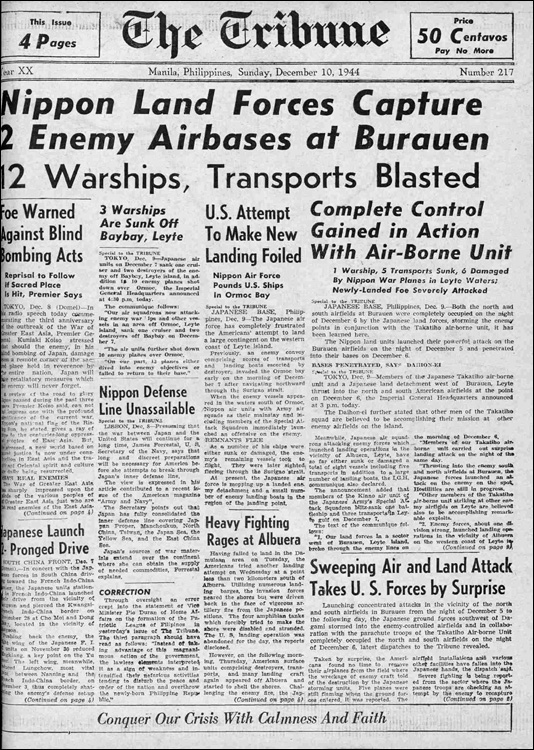
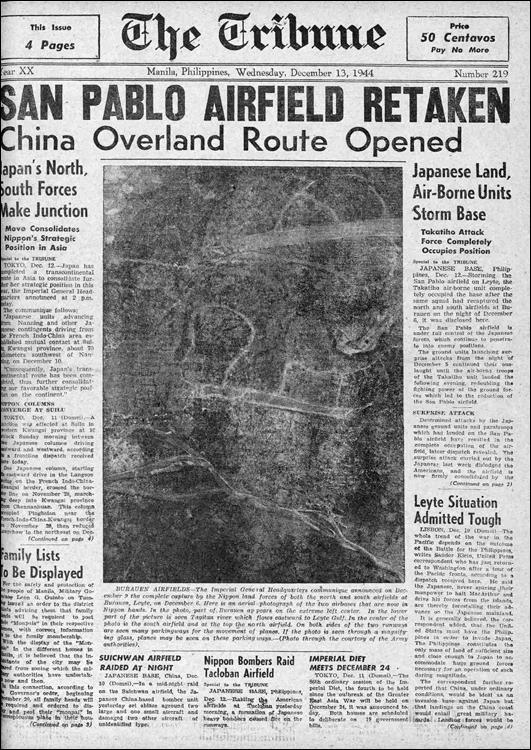
      At the time of the December 1944 attacks on American airbases on Leyte, Manila was still under Japanese control. The city's newspaper The Tribune covered those events from a pro-Japan viewpoint. For each article, here is a scan of how it appeared in the original newspaper, followed by my transcription of the text, which you may find easier to read.


December 8, 1944

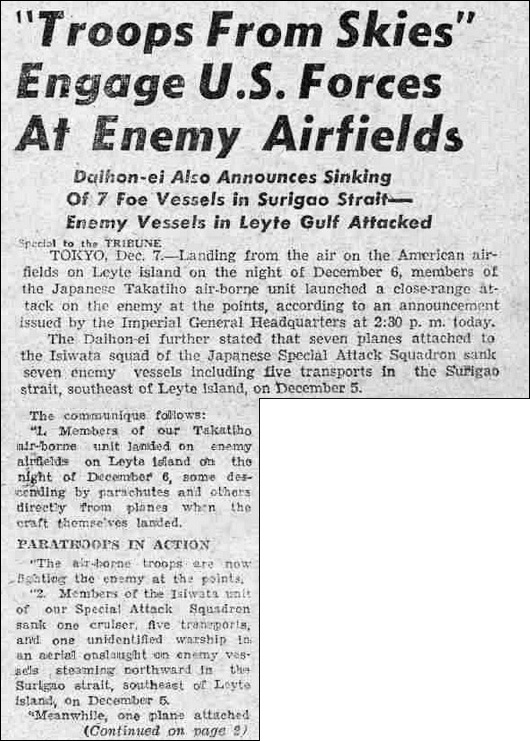
      Initial reports appeared in the December 8, 1944, issue. A special headline at the top of the page heralded the third anniversary (on Japan's side of the International Date Line) of the Pearl Harbor attack and what they called the Greater East Asia War.

Japanese Air-Borne Troops
Land on Enemy Bases in Leyte


"Troops From Skies"
Engage U.S. Forces
At Enemy Airfields


Dalhon-ei Also Announces Sinking
Of 7 Foe Vessels in Surigao Strait-
Enemy Vessels in Leyte Gulf Attacked


Special to the TRIBUNE
      TOKYO, Dec. 7. - Landing from the air on the American airfields on Leyte Island on the night of December 6, members of the Japanese Takatiho air-borne unit launched a close-range attack on the enemy at the points, according to an announcement issued by the Imperial General Headquarters at 2:30 p.m. today.
      The Daihon-ei further stated that seven planes attached to the Isiwata squad of the Japanese Special Attack Squadron sank seven enemy vessels including five transports in the Surigao Strait, southeast of Leyte Island, on December 5.

      The communique follows:
      "1. Members of our Takatiho air-borne unit landed on enemy airfields on Leyte Island on the night of December 6, some descending by parachutes and others directly from planes when the craft themselves landed.

PARATROOPS IN ACTION

      "The air-horne troops are now fighting the enemy at the points.
      "2. Members of the Isiwata unit of our Special Attack Squadron sank one cruiser, five transports, and one unidentified warship in an aerial onslaught on enemy vessels steaming northward in the Surigao Strait, southeast of Leyte Island, on December 5.
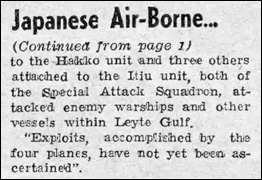
      "Meanwhile, one plane attached to the Hakko unit and three others attached to the Itiu unit, both of the Special Attack Squadron, attacked enemy warships and other vessels within Leyte Gulf.
      "Exploits, accomplished by the four planes, have not yet been as certained".

-------------------------------------------------

[photo caption: NIPPON PARATROOPS - Upper:- Members of the Takatiho air-borne unit boarding their transport plane at the base. Lower: Intrepid fighters seated in the plane ready to hop off on their mission.]


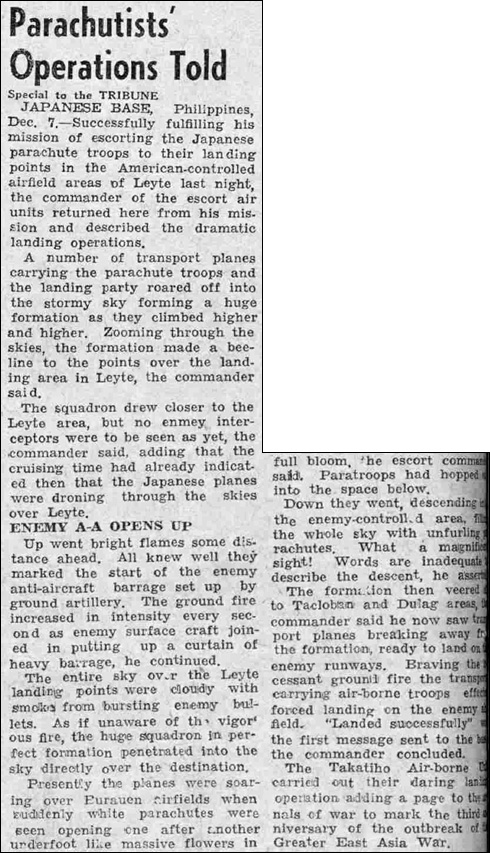
Parachutists'
Operations Told


Special to the TRIBUNE
      JAPANESE BASE, Philippines, Dec. 7. - Successfully fulfilling his mission of escorting the Japanese parachute troops to their landing points in the American-controlled airfield areas of Leyte last night, the commander of the escort air units returned here from his mission and described the dramatic landing operations.
      A number of transport planes carrying the parachute troops and the landing party roared off into the stormy sky forming a huge formation as they climbed higher and higher. Zooming through the skies, the formation made a beeline to the points over the landing area in Leyte, the commander said.
      The squadron drew closer to the Leyte area, but no enemy interceptors were to be seen as yet, the commander said, adding that the cruising time had already indicated then that the Japanese planes were droning through the skies over Leyte.

ENEMY A-A OPENS UP

      Up went bright flames some distance ahead. All knew well they marked the start of the enemy anti-aircraft barrage set up by ground artillery. The ground fire increased in intensity every second as enemy surface craft joined in putting up a curtain of heavy barrage, he continued.
      The entire sky over the Leyte landing points were cloudy with smoke from bursting enemy bullets. As if unaware of the vigorous fire, the huge squadron in perfect formation penetrated into the sky directly over the destination.
      Presently the planes were soaring over Burauen airfields when suddenly white parachutes were seen opening one after another underfoot like massive flowers in full bloom, the escort commander said. Paratroops had hopped off into the space below.
      Down they went, descending into the enemy-controlled area, filling the whole sky with unfurling parachutes. What a magnificent sight! Words are inadequate to describe the descent, he asserted.
      The formation then veered to Tacloban and Dulag areas, the commander said he now saw transport planes breaking away from the formation, ready to land out the enemy runways. Braving the incessant ground fire the transports carrying air-borne troops effected forced landing on the enemy airfield. "Landed successfully" was the first message sent to the base the commander concluded.
      The Takatiho Air-borne Unit carried out their daring landing operation adding a page to the annals of war to mark the third anniversary of the outbreak of the Greater East Asia War.


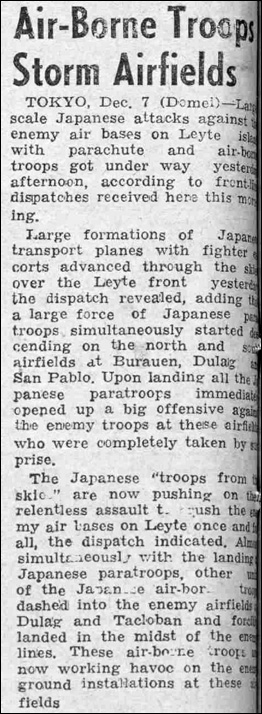
Air-Borne Troops
Storm Airfields


      TOKYO, Dec. 7 (Domei) - Large scale Japanese attacks against the enemy air bases on Leyte Island with parachute and air-borne troops got under way yesterday afternoon, according to front-line dispatches received here this morning.
      Large formations of Japanese transport planes with fighter escorts advanced through the skies over the Leyte front yesterday, the dispatch revealed, adding that a large force of Japanese paratroops simultaneously started descending on the north and south airfields at Burauen, Dulag and San Pablo. Upon landing all the Japanese paratroops immediately opened up a big offensive against the enemy troops at these airfields who were completely taken by surprise.
      The Japanese "troops from the skies" are now pushing on their relentless assault to crush the enemy air bases on Leyte once and for all, the dispatch indicated. Almost simultaneously with the landing of Japanese paratroops, other units of the Japanese air-borne troops dashed into the enemy airfields at Dulag and Tacloban and forcibly landed in the midst of the enemy lines. These air-borne troops are now working havoc on the enemy ground installations at these airfields.


December 10, 1944

Nippon Land Forces Capture
2 Enemy Airbases at Burauen

12 Warships, Transports Blasted

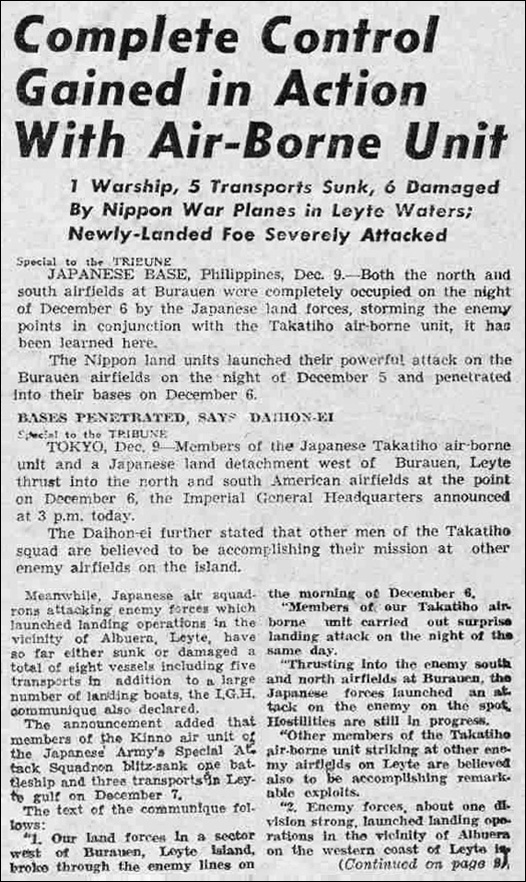
Complete Control
Gained in Action
With Air-Borne Unit


      1 Warship, 5 Transports Sunk, 6 Damaged
      By Nippon War Planes in Leyte Waters;
      Newly-Landed Foe Severely Attacked


Special to the TRIBUNE
      JAPANESE BASE, Philippines, Dec. 9. - Both the north and south airfields at Burauen were completely occupied on the night of December 6 by the Japanese land forces, storming the enemy points in conjunction with the Takatiho air-borne unit, it has been learned here.
      The Nippon land units launched their powerful attack on the Burauen airfields on the night of December 5 and penetrated into their bases on December 6.

BASES PENETRATED, SAYS DAIHON-EI

Special to the TRIBUNE
      TOKYO, Dec. 9 - Members of the Japanese Takatiho air-borne unit and a Japanese land detachment west of Burauen, Leyte thrust into the north and south American airfields at the point on December 6, the Imperial General Headquarters announced at 3 p.m. today.
      The Daihon-ei further stated that other men of the Takatiho squad are believed to be accomplishing their mission at other enemy airfields on the island.
      Meanwhile, Japanese air squadrons attacking enemy forces which launched landing operations in the vicinity of Albuera, Leyte, have so far either sunk or damaged a total of eight vessels including five transports in addition to a large number of landing boats, the I.G.H. oommunique also declared.
      The announcement added that members of the Kinno air unit of the Japanese Army's Special Attack Squadron blitz-sank one battleship and three transports via Leyte Gulf on December 7.
      The text of the communique follows:
      "1. Our land forces in a sector west of Burauen, Leyte Island, broke through the enemy lines on the morning o£ December 6.
      "Members of our Takatiho air borne unit carried out surprise landing attack on the night of ths same day.
      "Thrusting into the enemy south and north airfields at Burauen, the Japanese forces launched an attack on the enemy on the spot. Hostilities are still in progress.
      "Other members of the Takatiho air-borne unit striking at other enemy airfields on Leyte are believed also to be accomplishing remarkable exploits.
      "2. Enemy forces, about one division strong, launched landing operations in the vicinity of Albuera on the western coast of Leyte Island on the morning of December 7.

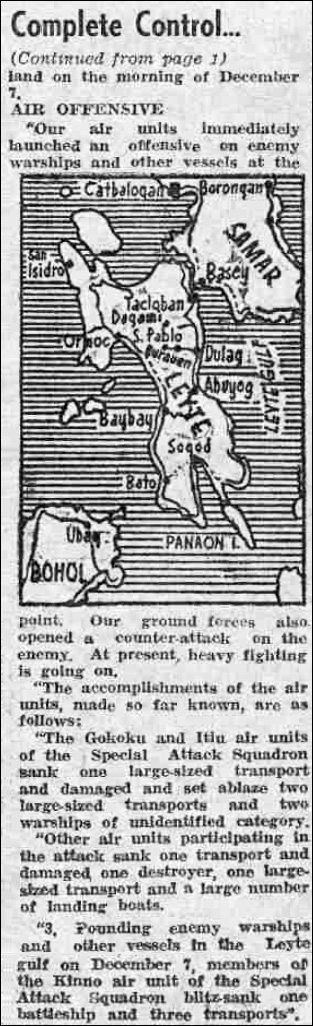
AIR OFFENSIVE

      "Our air units immediately launched an offensive on enemy warships and other vessels at the point. Our ground forces also opened a counter-attack on the enemy. At present, heavy fighting is going on.
      "The accomplishments of the air units, made so far known, are as follows:
      "The Gokoku and Itiu air units of the Special Attack Squadron sank one large-sized transport and damaged and set ablaze two large-sized transports and two warships of unidentified category.
      "Other air units participating in the attack sank one transport and damaged one destroyer, one large-sized transport and a large number of landing boats.
      "3. Pounding enemy warships and other vessels In the Leyte Gulf on December 7, members of the Kinno air unit of the Special Attack Squadron blitz-sank one battleship and three transports"


Sweeping Air and Land Attack
Takes U.S. Forces by Surprise


      Launching concentrated attacks in the vicinity of the north and south airfields in Burauen from the night of December 5 to the following day, the Japanese ground forces southwest of Dagami stormed into the enemy-controlled airfields and in collaboration with the parachute troops of the Takatiho Air-borne Unit completely occupied the north and south airfields on the night of December 6, latest dispatches to the Tribune revealed.
      Taken by surprise, the Americans found no time to remove their airplanes from the field where the wreckage of enemy craft told of the destruction by the Japanese storming units. Five planes were still flaming when the ground forces entered, it was reported. The airfield installations and various other facilities have fallen into the Japanese hands, the dispatch said.
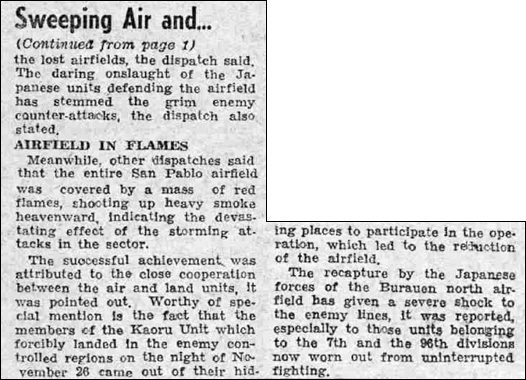
      Severe fighting is being reported from the sector where the Japanese troops are checking an attempt by the enemy to recapture the lost airfields, the dispatch said. The daring onslaught of the Japanese units defending the airfield has stemmed the grim enemy counter-attacks, the dispatch also stated.

AIRFIELD IN FLAMES

      Meanwhile, other dispatches said that the entire San Pablo airfield was covered by a mass of red flames, shooting up heavy smoke heavenward, indicating the devastating effect of the storming attacks in the sector.
      The successful achievement, was attributed to the close cooperation between the air and land units, it was pointed out. Worthy of special mention is the fact that the members of the Kaoru Unit which forcibly landed in the enemy controlled regions on the night of November 26 came out of their hiding places to participate in the operation, which led to the reduction of the airfield.
      The recapture by the Japanese forces of the Burauen north airfield has given a severe shock to the enemy lines, it was reported, especially to those units belonging to the 7th and the 96th divisions now worn out from uninterrupted fighting.


EDITORIAL

Sweeping Out the Invaders

      The Imperial General Headquarters communique made public for the first time yesterday the penetration of the enemy airfields at Burauen by Japanese land units on December 6. In conjunction with the air-borne Takatiho units that landed in the vicinity, staggering blows were dealt upon the enemy. Both the north and south Burauen airfields have been captured by the Japanese.
      With the fourth year of the war, the armed struggle in Leyte has taken on added intensity. The Japanese forces have gradually upped the tempo of attack and more large scale thrusts into the main enemy lines are being launched. On the other hand, the enemy side has not been idle. A new batch of reinforcements has been landed to support the already badly battered American troops. But the reckless enemy landing was fiercely contested by the Japanese defenders, the enemy losing some dozen warships and transports, including a battleship. In addition, numerous landing vessels were destroyed.
      The Nippon air force has continued its devastating attacks on the enemy naval forces and transport fleet, more than 21 warships and transports being blasted on December 5 alone. The Kamikaze special attack squadron of the Navy and the special attack units of the Army are taking the major role in this crippling sorties against enemy surface craft.
      As the Japanese forces are fighting on the Leyte battlefront, the Philippines home front has been consolidated by the birth of the Makapili, and a correlated setup for the propelling of the totalian defense of the Philippines has been perfected.
      At this juncture, it is a matter of utmost significance that General Tomoyuki Yamasita, the Highest Commander of the Japanese Army in the Philippines, in his congratulatory message at the inauguration of the Makapili, again voiced His confidence of annihilating the "second Magellan" of Leyte, with a reassuring "I will crush the enemy."
      We are sure that the General has ample reasons for making such a definite statement. It may take some time but the complete sweeping out of the Leyte invaders is sure to come.


December 12, 1944

NIPPON PRACTICALLY HAS
COMMAND OF AIR OVER P.I.


Special to the TRIBUNE
      JAPANESE BASE, Philippines, Dec 11. - The command of the air over the Philippine front is practically in the hands of the Japanese air force.

      The American air unit on Leyte Island has already withdrawn its headquarters from the front.
      Radio in the enemy camp admits that the Japanese have strengthened their air force in the Philippine area far more than before. The enemy points out that he has suffered serious losses in manpower and arms as well as war materials as a result of the continuous attacks of the members of the Japanese Special Attack Squadrons.
      Airfields on Leyte Island the Americans are using are only those at Tacloban, Dulag, and Damulaan. That at the last-mentioned point is a recent construction.
      Because facilities at the airfields are still restricted, they are not available for the landing of large-sized planes. Small-sized craft landing on and taking off from the fields are also limited in number.
      American planes raiding various points in the Philippines on December 9 total less than 20. Reports say that most of them came from Morotai Island in the Moluccas group to raid Davao and Zamboanga.
      The enemy forces launching landing operations in the vicinity of Albuera on December 7 are not escorted by either carrier-borne planes or Philippine-based fighters.
      Naturally, the Japanese air force could fully bomb and strafe enemy troops without suffering any obstruction.


December 13, 1944


CLICK IMAGE FOR ENLARGEMENT

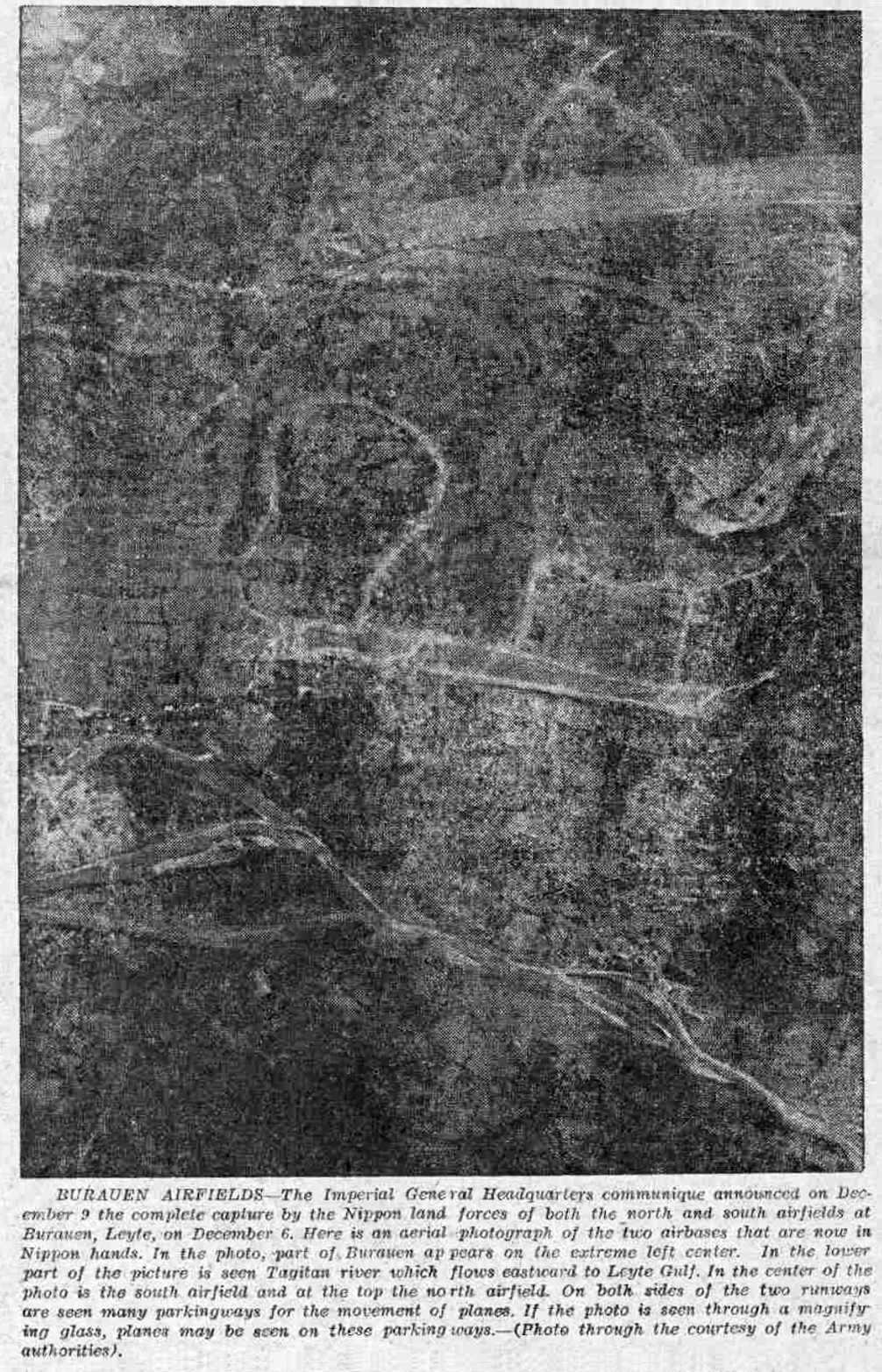
      BURAUEN AIRFIELDS - The Imperial General Headquarters communique announced on December 9 the complete capture by the Nippon land forces of both the north and south airfields at Burauen, Leyte, on December 6. Here is an aerial photograph of the two airbases that are now in Nippon hands. In the photo, part of Burauen appears on the extreme left center. In the lower part of the picture is seen Tagitan [Daguitan] River which flows eastward to Leyte Gulf. In the center of the photo is the south airfield and at the top the north airfield. On both sides of the two runways are seen many parkingways for the movement of planes. If the photo is seen through a magnifying glass, planes may be seen on these parkingways. - (Photo through the courtesy of the Army authorities.)


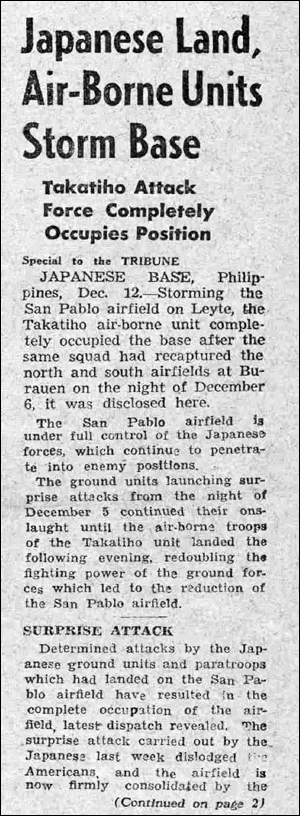
SAN PABLO AIRFIELD RETAKEN

Japanese Land
Air-Borne Units
Storm Base


Takatiho Attack
Force Completely
Occupies Position


Special to the TRIBUNE
      JAPANESE BASE, Philippines, Dec. 12. - Storming the San Pablo airfield on Leyte, the Takatiho air-borne unit completely occupied the base after the same squad had recaptured the north and south airfields at Burauen on the night of December 6, it was disclosed here.
      The San Pablo airfield is under full control of the Japanese forces, which continue to penetrate into enemy positions.
      The ground units launching surprise attacks from the night of December 5 continued their onslaught until the air-borne troops of the Takatiho unit landed the following evening, redoubling the fighting power of the ground forces which led to the reduction of the San Pablo airfield.

SURPRISE ATTACK

      Determined attacks by the Japanese ground units and paratroops which had landed on the San Pablo airfield have resulted in the complete occupation of the airfield, latest dispatch revealed. The surprise attack carried out by the Japanese last week dislodged the Americans, and the airfield is now firmly consolidated by the Nippon forces, the reports said.
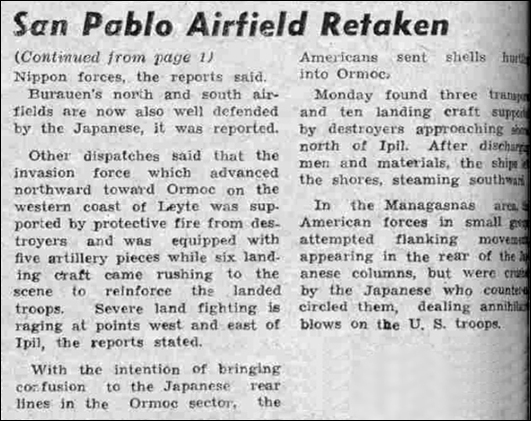
      Burauen's north and south airfields are now also well defended by the Japanese, it was reported.
      Other dispatches said that the invasion force which advanced northward toward Ormoc on the western coast of Leyte was supported by protective fire from destroyers and was equipped with five artillery pieces while six landing craft came rushing to the scene to reinforce the landed troops. Severe land fighting is raging at points west and east of Ipil, the reports stated.
      With the intention of bringing confusion to the Japanese rear lines in the Ormoc sector, the Americans sent shells hurtling into Ormoc.
      Monday found three transports and ten landing craft supported by destroyers approaching shores north of Ipil. After discharging men and materials, the ships left the shores, steaming southward.
      In the Managasnas area, the American forces in small groups attempted flanking movements appearing in the rear of the Japanese columns, but were crushed by the Japanese who counter-circled them, dealing annihilating blows on the U.S. troops.


December 17, 1944

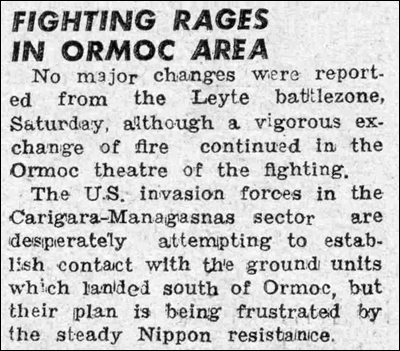
FIGHTING RAGES
IN ORMOC AREA


      No major changes were reported from the Leyte battlezone, Saturday, although a vigorous exchange of fire continued in the Ormoc theatre of the fighting.
      The U.S. invasion forces in the Carigara-Managasnas sector are desperately attempting to establish contact with the ground units which landed south of Ormoc, but their plan is being frustrated by the steady Nippon resistance.


BACK TO: December 6-8, 1944: Jap Paratrooper Attack

Read more issues of The Tribune on the Australian government's "Trove" site

BACK TO HOMEPAGE


ElectricEarl.com

This page established: March 20, 2025             Last updated: April 9, 2025

© 2025 Earl P. Reinhalter. All Rights Reserved.