Album Review (vinyl LP)
The Tower
by
Old Grey Horror

Welcome to waitaminutechester.com, a very cool place to be.
One of the things you are apt to find here is some of the writing, and some of the music-related interviews, of Steve Roeser.
This site is dedicated to the memory of The Band, especially to its five original members:
Richard Manuel (1943-1986)
Rick Danko (1943-1999)
Levon Helm (1940-2012)
Robbie Robertson (1943-2023)
Garth Hudson (1937-2025)
This site is named for a line in their greatest song, "The Weight," recorded by The Band in 1968 and included on their debut album, Music From Big Pink.
A classic, timeless song created by one of the greatest bands of all time.
The Tower
by
Old Grey Horror
World War I concluded more than a century ago.
It's unlikely that anyone still alive today could even recall hearing someone (an older relative perhaps) talk about how that war (1914-1918) impacted their lives.
But in many ways, World War I still matters. It started the whole universal madness that has never really ended. The madness and insanity that gradually made the entire concept of war, by the latter stages of the Twentieth Century, not only acceptable but almost routine.
The corruption, cynicism and evil that turned war into a business. War became "a racket." And that's where we are today.
The "naive" idea of establishing "peace on earth" long ago became a silly "pie in the sky" notion, regarded by all "realistic" people as ridiculous, downright laughable.
What led the world's richest countries to eventually embrace and perpetuate this seemingly permanent frame of mind was aided greatly by United States involvement in WW I (1917-18).
I can think of three movies that I saw, many years ago, that had the First World War as a backdrop. I thought all three were very good films, and each affected me in a different way.
But I had never listened to a rock music album (never before even heard of one) that had World War I as its subject matter.
Just imagine if the original lineup of Black Sabbath (yes, the same guys who created the classic recording called "War Pigs") had decided, early in their career, to write and record a "concept album" about either World War I or World War II.
Well, they didn't. They could have done it, but they just never did get around to it.
But Old Grey Horror did. And it's called The Tower.
Historians tell us that it was the assassination of the Austro-Hungarian Archduke Franz Ferdinand, by a Bosnian Serb student activist (in Sarajevo in June 1914), that lit the fuse. One month later Austria Hungary declared war on Bosnia.
The Tower opens with the track "Franz Ferdinand Must Die," setting the table for a unique record that provides a brief yet powerful re-cap of World War I in a hard rock setting.
Without pegging this recording project as entirely Sabbath-influenced, that is not meant in any way as a criticism. To the extent that anyone would categorize Black Sabbath music as "metal," then The Tower is certainly in that vein.
But, as with any great Sabbath album, not every track is loud, heavy, frantic or banging its way into your brain. Some are, some certainly do. It's all about war, don't you see.
But this record is paced to include what Tony Iommi used to call "light and shade." And it works.
The killer track on Side A is "Into The Teeth." This one is more in the "speed metal" groove. You can find your own model for this type of sound. I'm thinking Motorhead, but in any case it's impressive.
The lyrics are frightening, especially when you consider mostly teenaged (or slightly older) young men ordered to the front lines. In many instances death was more of a likelihood than a possibility.
This is an album about death, destruction and annihilation, the songs based on true events. This isn't the soundtrack to some Hollywood horror movie. This music is about real life horror.
Those kids, many of them, went to war and never came back alive. Not so different from today's war reports, that you can hear right before or after listening to this record. Not much has changed in a mere hundred years.
The Tower is the brainchild of producer J. Adams, who was involved in every aspect of the project, from the writing, to leading the band (a very talented crew of collaborators who shared his vision), to the vocalizing.
Most of his songs here are written from the point of view of a young soldier who doesn't want to die on the battlefield. One who is also so terrified that he can't think straight, just totally charged on adrenaline.
Estimates were that the total number of soldiers killed in this war possibly exceeded 10 million. This had to be a heavy metal album. No other music could communicate the living hell of having to crouch in a muddy foxhole for days and nights on end, engulfed by mortar shells and mustard gas.
Songs like "Over The Top," "Everyone Must Die" and particularly "Trommelfeuer" convey the nightmare the soldiers had to face. War is hell? Listen to these songs.
But the album also includes the other side of this situation: when the shelling stopped long enough to allow for reflection. That's what "One More Day" and "Christmas, 1914" are about.
These quieter songs express the hopes of the men in the trenches, that they might simply survive, until the day this unspeakable thing was finally over.
The three World War I-related films I saw were The Grand Illusion (1937, directed by Jean Renoir), Sergeant York (1941, Howard Hawks) and Johnny Got His Gun (1971, Dalton Trumbo). But the order in which I saw them was Sergeant York, when I was a kid, Johnny, in high school, Illusion, in my twenties.
Trumbo was a blacklisted screenwriter, Johnny Got His Gun being his only movie as director. Hawks is considered to be among the great Hollywood directors, and he got Gary Cooper to play the title role. The part Cooper played was based on the true story battle heroism of an American soldier, Alvin York of Tennessee.
Renoir, the French filmmaker (later relocating to Hollywood) made a few classics in his career, and The Grand Illusion is one of them. For many decades, it has been included on lists of the greatest films of all time.
We are probably due for another talented filmmaker to undertake a project that pertains to World War I.
J. Adams, using concepts, songs, music, studio techniques and lots of creativity, has contributed in his field something that's just as formidable as what a novelist, journalist, playwright, filmmaker or classical composer is capable of.
He could have chosen a different focus for his album project, or a different historical era, but the result with The Tower is unquestionably successful.
This album is highly recommended.
-Steve Roeser
 |
 |
|
| Chronicles: Volume One by Bob Dylan (2004) |
Testimony by Robbie Robertson (2016) |
I don't recall ever having written anything before about either of these books, but I will be as brief as possible as they both came out years ago. However, as of this writing (Spring 2025), there is word that the long-awaited sequels to both of these works are due for publication soon.
What I do recall is that when I bought Dylan's book and read it when it was first published two decades ago, I was somewhat disappointed. I remember having the feeling, or the impression, that the author wasn't being particularly "honest." That's what I thought.
Martin Scorsese's Dylan documentary (No Direction Home) was released around the same time, and I ended up liking that a whole lot more than Dylan's book. Maybe I didn't give the book a fair assessment back then. After all, Bob "was so much younger then" (he was only in his '60s), and I tend to regard this book a bit differently at this point in time.
Chronicles: Volume One, I can now honestly say, has a lot to offer any Dylan fan who has hung in for the ride over the course of multiple decades. It's mostly about his early times in New York City, but the narrative jumps around in time, and there's a section about the making of his album Oh Mercy in New Orleans with Daniel Lanois, U2's producer.
But in the first part, pages 13-15, he talks about Ricky Nelson (1940-1985) and how much he liked him and could relate to him. Dylan referred to Nelson's song "Garden Party" (in which Dylan is mentioned).
Well, wouldn't you know it, but 20+ years later, out on tour yet again with a different Nelson (Willie) in 2025, Dylan decided to close his part of the show by singing "Garden Party." Days later I saw a video clip of Rick Nelson's twin sons (who are musicians) talking about the fact that Dylan had written about their Dad in Chronicles years ago, and then surprised everybody by busting out this cool "Garden Party" cover in concert. Stuff coming full circle once again.
And I had not noted before the nice words Dylan had for his parents in the book. He recalled returning to Minnesota for his father's funeral: "...my father was the best man in the world and probably worth a hundred of me..."
There's lots more good writing and good stories contained in the book (including one about meeting John Wayne on a movie set in 1966). There's just so much more to this book than I'd ever realized.
Testimony, written solely by Robbie, covers his first 33½ years, beginning with his family memories, born and raised in Canada, and concluding with the Last Waltz concert in San Francisco in November of 1976. He intended for the book to end there, the rest of his life story to be covered in Vol. 2 of his memoirs.
There is little more to be said about the book now (I read it while Robbie was still alive, but years after it had been published) other than, it's a story all true fans of The Band really ought to read. Especially since Levon is the only other member who told his story in a book (This Wheel's On Fire, published many years before Robertson's book). Levon's book is also a must-read.
Even if Robbie isn't your favorite member of The Band, he had a great memory for details. There a lot of history here. After the filming of Scorsese's Last Waltz, Robbie never toured as a member of The Band again. (Later, of course, The Band reunited without him and continued on.)
Testimony really is, mostly, all about his time in the group (starting at age 16), the years playing with Ronnie Hawkins as the Hawks, meeting Dylan and doing the 1966 world tour as his band, and everything else that preceded their albums on Capitol Records. The years on Capitol are also thoroughly covered, as you'd expect.
There's also quite a bit in the book about Robbie's friendship with Dylan (and also about his early friendship with Levon, before they had their "falling-out"). When Robbie died in 2023, Dylan released a statement that talked about their long relationship.
The sequel will cover Robbie's solo work, and his extensive working relationship with Scorsese.
As far as books on The Band (the one by Barney Hoskyns being another outstanding book, from the perspective of a writer across the ocean), it may have its flaws, but Robbie's work simply cannot be discounted.
Robertson was there, he lived it just as much as the other guys did, and this is his testimonial artifact on the subject that he left behind.
-Steve Roeser
The following is a previously unpublished article that I wrote in 2006, while George W. Bush was still President. At the time I was thinking about the career of Bruce Springsteen, and the kinds of songs he was writing back then.
I had followed Springsteen's progress since the release of his debut album in 1973. I was a fan in the 1970s, but not really after that era. I was still somewhat interested in what he was doing after the 1980s, but I was mostly into his first five or six albums, and that's about all.
(One of Bruce's few connections to The Band is that they covered his song "Atlantic City" on the album Jericho (1993), about a decade after it appeared on the Springsteen album Nebraska.)
THE BAND: Atlantic City
The Band's version of "Atlantic City," written by Bruce Springsteen
As someone who was born and raised in New Jersey, I had some thoughts I wanted to express about this recording artist. If Bruce Springsteen is not the most famous singer from my home state, he's close. Only Frank Sinatra and Frankie Valli could compete with him on the fame level.
I had hoped to get this piece published before the end of 2006, but it wasn't to be. Reluctantly, I filed it away. Many years later, I came across it again. So, here it is.
Catholics, Republicans and Rock 'n Roll
by
Steve Roeser
Like the folksinger John Gorka, "I'm from New Jersey." I like Gorka's sentimental song with that title about the Garden State just about as much as I like any Bruce Springsteen song I've ever heard. John's not nearly as famous as Bruce, but that's okay. Both of these guys have written and sung some great songs.
Not every rock music fan over 40 is a Bruce Springsteen fan, but this guy still has got a lot of fans. And deservedly so. Springsteen is not a Republican, but even a lot of Republicans would admit (at least privately) to being fans of Bruce Springsteen.
Because, once a fan, you can forgive a lot. And Bruce has given a great many people a lot of pleasure over the years, with his songs and his singing and his guitar playing, and his albums and his concerts. Including a lot of Republicans.
Now, most Republicans who would admit to being Bruce Springsteen fans would qualify their love of what he's done. They are fans, most likely, of what he did with the E Street Band, and what he did during the first 10 or 12 years of his recording career. A career that began, for all intents and purposes, in the early 1970s.
(Springsteen was born in 1949, raised Catholic, and had almost no formal education beyond high school.)
When Bruce Springsteen started out he probably described himself, or at least thought of himself, as a rock 'n roll musician. As he put it in a song from his fifth album, The River (1980), "Baby, I'm a rocker!"
Today he'd probably identify his occupation as "musician" or perhaps "songwriter." But sometimes Springsteen sings other people's songs, like he just recently did with the works of Pete Seeger and Woody Guthrie. And it just so happens that one of his most popular live recordings, "Jersey Girl," is a song he didn't write.
What he never describes himself as, and never has (certainly not to my knowledge), is "politician." Some people, since he turned 50 in 1999, have (I've heard) floated the notion that Springsteen should consider the idea of running for some political office in his native New Jersey. That's their problem.
Springsteen, probably to his own chagrin, is a celebrity (of course), but that comes with the territory. He is also a rich man. He's also a target for those who don't dig him, or for people who once did like him but don't like him anymore.
On the eve of the 2004 presidential election, Springsteen came out publicly in support of Democratic candidate John Kerry. He was openly critical of the actions of the Bush/Cheney administration, taking the position that it was best for America that they be voted out of office and denied a second term.
But Kerry lost his presidential bid, and Bruce Springsteen caused a lot of his Republican fan base to turn against him, seemingly for no good reason. Except that maybe he was being honest, and it could be that that's the way he really felt. Maybe he was simply stating things with the courage of his true convictions.
Around the same time, Springsteen released an album that included songs perceived as critical of the war in Iraq, and the people (politicians) who put us there, with all the resulting death, and massive cost yet to be paid. At that point Springsteen definitely caused some polarization amongst his fans, but he surely knew beforehand that he would.
Non-Republican Springsteen fans saw him (if they hadn't already) as courageous for speaking out through his music, even patriotic. Some of his Republican fans didn't like it (might have even generously said "Well, that's just his opinion..."), but still remain fans of his early music.
But then, there are other Republicans who now simply hate Springsteen's guts for so blatantly revealing his political opinions. He lost those people, probably forever. The hard-liners who once liked Springsteen, maybe even openly admitted to being fans, more likely cringe at the mere mention of his name now (unless it's being dragged through the mud), and would just as soon burn their old Bruce Springsteen albums.
You can't exactly say that it's "a good career move" to alienate a big segment of your audience by publicly revealing your political preference, and then actively campaigning for your candidate of choice.
But does anyone remember another singer from New Jersey who used to do things like that? His name was Frank Sinatra. Springsteen, a fan of Ol' Blue Eyes, sang at his 80th birthday tribute in 1995.
Frank was possibly the most famous Democrat who became a Republican later in life. There's lots of contradictions about Sinatra. There were when he was alive, and there still are now that he's gone.
Some people may still find it confusing, if not distasteful, that Frank was a supporter of both John F. Kennedy and Ronald Reagan.
Like Springsteen, like many people in the music business, Sinatra (also a Catholic, albeit one of dubious stature) was a far-from-perfect human being, no matter how many fans he had, or how much influence he might have had.
(Bruce and Frank have quite a lot in common, actually, aside from the fact that Sinatra detested rock 'n roll.)
But, as Frank once commented about himself and how he was perceived by the public: "No matter what anybody says about me, I know that when I sing, I believe." Any Sinatra fan, as well as anyone who knows his recordings, has to agree that this is true.
Springsteen, if he cared to, could pretty much make that exact same statement about himself.
Republicans loved the post-Kennedy Frank Sinatra, and they loved the Bruce Springsteen who (like The Beach Boys did) sang about cars and girls when he was a young man. They even loved him when he sang "Born in the U.S.A.," the title song of the biggest-selling album of his career.
Of course, most of the Republicans who love that record (and if you sell 10 or 15 million copies of one particular album that means you have achieved crossover acceptance from all strata of society, politics aside), never really listened to the words of that song, or read them.
They just remember the image of a muscular Bruce in the music video, wearing the bandana around his head, pumping his fist in the air, singing about his pride in being an American. Well, he probably was (and is) proud, but it was a bittersweet kind of pride.
Reagan's people even tried to co-op Springsteen's music, as some may remember. It didn't work, but Reagan got re-elected anyway, just like George W. Bush did.
I saw Springsteen and his E Street Band at Dodger Stadium on August 17, 2003. The big ballpark was probably sold-out that day, or quite nearly. This was one year before Bruce threw his support fully behind the Democratic challenger to a sitting Republican president. A pretty good concert, and a lot of cheering for Bruce on that nice summer day.
One of the least musically-inspired moments of the entire show (in my humble opinion) came near the end, when the band went into one of Bruce's big hits of the '80s, "Dancing in the Dark." Compared to most of the songs he's written, this one is a trifle.
I hadn't realized it all through the concert but I must've been sitting right in the middle of a gaggle of Springsteen's Republican fans. As the strains of "Dancing in the Dark" blasted through the stadium P.A. system, suddenly people all around me (most of them much younger guys wearing wacky hats) jumped to their feet and started dancing like idiots.
This was Los Angeles remember, not Orange County/Anaheim.
It was literally as if these guys had paid $75 a ticket (parking not included) just to hear this ONE song. And up till that moment, before the band started playing it, before Bruce started singing it, it was like these chuckleheads had been sitting there thinking, "Damn, if he doesn't play 'Dancing in the Dark' before he's done then I came out here for nothin', because I'm not into these other songs he's up there singing..."
What a relief it must have been when he finally got to it!
Three years later, during the dog days of August '06, a story surfaces about Bruce Springsteen. The story was about his personal life, and it starts making the rounds of the TV entertainment programs like Access Hollywood and such.
The story first appeared in the New York Post, the newspaper relying on "unnamed sources" to do its reporting. Supposedly, Springsteen was (contemplating) leaving his wife Patti, a longtime member of his band and mother of their three children, for another woman.
Details were also laid out that the anonymous other woman was a 9/11 widow, Springsteen reportedly having met her shortly after the attacks. Days later, on a Springsteen website (brucespringsteen.net), the songwriter responded by denying that the story had any validity. He also stated that he and his wife remained committed to each other and their family.
The New York Post is not a newspaper that ever gave Bill Clinton or Al Gore much of a break. Or ever cut any Democrat very much slack. And if New York's senator, Hillary Clinton, does run for president, she will be getting no endorsement from the New York Post. That's guaranteed.
The New York Post also ran a photograph in 2005 of Springsteen talking with a woman at some unspecified time or place, the implication being (the very reason that the newspaper bought the photo and printed it) that perhaps Bruce Springsteen wasn't exactly always entirely faithful to his wife. (As if most, if not all, celebrated rock stars would never even think of cheating on their wives.)
It certainly seemed like somebody was sending a message, by way of this handy media outlet (the Post): "Hey Springsteen, it's payback time."
In New Jersey, this is what used to be called "dirty pool."
At the time Springsteen was doing concerts without his E Street Band (ones that were not selling out, because precious few Republicans were willing to buy tickets), promoting an album that seemed to be critical of the war in Iraq. Bruce was likely feeling the backlash of having supported John Kerry, the Democratic senator who tried to defeat George W. Bush.
Where were the partying fools from The Rising Tour who'd been calling out to the stage for "Dancing in the Dark"?
The late summer 2006 story about the alleged breakup of Springsteen's marriage was curiously-timed. The mid-term elections were just a little more than two months away. Was it "just a coincidence," or did some "clever operative" come up with a little scheme involving a certain "major rock star?" Might it not help matters for Republican politicians across the board if a Democratic icon like this Bruce Springsteen guy could be effectively tarred with some bad publicity right about now?
Bruce is Catholic. Maybe a "fallen-away" Catholic (like many Republicans also are, though they try much harder not to appear so), but still a Catholic, nonetheless. And why shouldn't your average Catholic rock music fan, especially one from New Jersey, feel a little pride over Bruce Springsteen? He's one of ours, one of us, and he made it big.
My Jewish friends often remind me of who their icons are (not that I mind): Neil Diamond, Bob Dylan, Seinfeld, Paul Simon...So, why shouldn't I sense some pride in a fellow Catholic guy, my man Springsteen?
When 9/11 happened, Springsteen's New Jersey community was hit hard. Bruce could look across the water on that terrible Tuesday and see the smoke rising from the Twin Towers site. He knew families who had lost people that day.
Like most of us, he was in shock over what had happened. So much so that the following Sunday he took his family to Mass, something he doesn't normally do.
So, maybe Springsteen is a "C&E" type Catholic (Christmas & Easter). Also, being as famous as he is, maybe he doesn't want to be asked for his autograph every time he goes to church. But, in his own way, he is probably still a believer.
Many of us can clearly recall that, early in 2003, the late and beloved Pope John Paul II prevailed upon President Bush not to go to war against Iraq. As it became clear that the invasion was likely to go ahead as planned, the Pope made a fervent plea for peace, which fell on deaf ears (with a resounding thud) in the White House and at the Pentagon.
Looks like Bruce Springsteen and Pope John Paul, a couple of well-known Catholics, were on the same page on that one.
Springsteen is a rocker, yes. And he's an entertainer, yeah. But he's also a gifted creative artist, who has amassed a very impressive body of work over several decades. Put Springsteen's accomplishments in HIS field up against those of any one of the various people who might try to tear him down, and most likely that person's resume is just not going to stack up in comparison. Probably not even close.
The fact is, like him or not, Springsteen is one of the top people in his game, and that can't be denied. And, this being America (where freedom should always ring, and ring true), Bruce Springsteen, just like any other writer of songs, ought to have the perfect right to take on any subject or topic he sees fit, personal, social or political.
And if that includes writing anti-war songs that might very well be written with a present-day war in mind, then so be it.
Only the most avid Springsteen fans know it, but one of his earliest songs is called "If I Was The Priest." It's an obscure song amongst his works, yet it's there. When he wrote it, maybe the thought crossed his mind that someone in his life might not like it if he used these ideas as subject matter for a song.
Maybe, as a Catholic (because of the strong indoctrination he'd received as a child), he was possibly afraid that such a song could be regarded as "blasphemous."
Young songwriters are often brave, but that doesn't mean they are without any fears. Maybe Bruce did fear a disapproving reaction from his parents, his family, someone in the Church, maybe from a Catholic priest he might even have known personally.
But he went ahead and wrote the song, and he finished it. As an aspiring artist, he had to. He had little choice in the matter.
An artist takes the raw, real-life material from his world, and he (or she) turns it into art. Springsteen's art is his music, his songs, and his performance of those songs.
It had been a long time since I really cared much about hearing the latest Bruce Springsteen album, but The Rising (2002) is one that I did want to listen to. I wanted to hear what was on Springsteen's mind at that point. I wanted to take in these new songs.
When it was released, The Rising was not only perceived as, but also promoted as, Springsteen's response to the events and the aftermath of 9/11.
Yet, the best song on the album, the gospel-structured "My City of Ruins," actually had nothing to do with 9/11. This despite the fact that he and his band members performed it on a special TV telecast in September 2001 (America: A Tribute to Heroes) honoring all those who had lost their lives that day.
The album was critically-acclaimed, and it was a good album, but I felt personally that it did not amount to being even one of the top five albums Bruce Springsteen has ever recorded.
But I would definitely rank "My City of Ruins" (the first and only Springsteen recording I've loaded onto my iPod) as one of his greatest songs, one that no one else could sing with the same passion and meaning that he can. When The Rising came out (and surely when so many people heard him sing it on the 2001 live telecast), the implication was that Bruce was singing about New York City, and the devastation that had occurred there.
But he wasn't. He had written the song long before 9/11. And he'd written it about his old stomping grounds, Asbury Park, New Jersey, which had deteriorated into a virtual ghetto by the 1990s.
Bruce and his fellow musicians had always played at the legendary local club (the legend, of course, built primarily due to Springsteen himself), The Stone Pony, which he and others had fought to keep in operation when it looked like it might have to finally close down.
To this day, fans arrive at The Stone Pony with the knowledge that on any given night, Bruce Springsteen (if he's home) might feel the urge to drive over and get up on stage to perform an impromptu set.
And who could name a single hard-line Republican onetime Springsteen fan who'd pass up the opportunity to see that, if he had a little inside information that this was the night?
"My City of Ruins " is such a great song because it's so personal to the guy who wrote it. Ultimately, Bruce Springsteen is every bit as sentimental and as traditional as any Republican ever could be. The things that were a part of him when he was growing up in the Fifties and Sixties are obviously still a part of him: his working-class New Jersey roots, for example, and his Catholic upbringing.
And he can never forget that, or rid himself of it. Nor would he want to, because all of his wonderful creativity sprung from that.
Catholic families in New Jersey used to, in the days of JFK, gather around some evenings after supper and pray the Rosary together. The expression we knew, and heard repeated many times was, "The family that prays together, stays together."
If you listen closely to "My City of Ruins," you can hear the voice of Patti, Springsteen's wife, behind his. For the Springsteens, the expression might be, "The family that sings together, stays together."
I defy any Republican hard-liner, one who feels compelled to curse the name of Bruce Springsteen, to listen to "My City of Ruins" through a good set of headphones and not be moved by it. Emotions aside, on an objective level most people would have to say, "This guy is truly an artist."
Film director Taylor Hackford's documentary about Chuck Berry includes an interview with Springsteen in which Bruce recalls the time, very early in his career, when he and his musicians served as Berry's backup band on a particular gig. For no pay.
The notorious Chuck Berry, one of rock 'n roll's greatest founding fathers, is not someone who most Republicans would publicly pay homage to, although many of them undoubtedly love his early records. The one most commonly cited is, of course, "Johnny B. Goode."
In that documentary, Chuck explains that "rock 'n roll" (and when Bruce Springsteen was born there was no such expression used to label a form of popular music) was essentially a slang term for sex.
When rock 'n roll exploded as a worldwide phenomenon in the mid-to-late 1950s, conservative groups within the United States (no doubt with a great many Republican Catholics on board) tried to ban this music and have it completely erased from the culture at large.
Before The Beatles arrived on our shores in 1964, this concerted movement/campaign actually did have some widespread success in achieving its aims.
The wild, untamed rock 'n roll recordings and performances of such pioneers as Little Richard, Jerry Lee Lewis (who recently made a recording of the Springsteen song "Pink Cadillac"), Gene Vincent and Elvis Presley, among others, were replaced in the early Sixties by much more "polite," socially acceptable singers (more acceptable to Republicans, essentially) like Fabian, Bobby Rydell, Bobby Vinton and Chubby Checker.
But that stuff was pop music. Bruce Springsteen got hooked on the rock 'n roll that Chuck Berry was talking about. There used to be, before he became a publicly-recognized family man, "a whole lotta sex" in the music of Bruce Springsteen.
And occasionally some of that even resurfaces in one of his new songs. But mostly, that was "the Bruce of the old days," when (as James Brown might put it) he was "single, and ready to mingle."
A lot of Springsteen's early songs and recordings are supercharged with sex, and he's probably not all that embarrassed by it. And why should he be? After all, that's who he was then, when he was a teenager, and when he was in his twenties, and even after that.
In the 1980s, Springsteen got married for the first time, perhaps with the idea of settling down, now that he'd become truly successful. But his first marriage (which resulted in no children) did not work out.
(The New York Post story included the inaccurate information that Patti has been his wife "of 20 years," when in fact Springsteen was with his first wife in 1986.)
But because (it seems) Springsteen really is as traditional as he appears to be when you come right down to it, he tried marriage again. And that's when "the storybook narrative" took hold. The ultimate rocker dude did settle down to become a good husband and father.
And that's something that all good Republicans, as well as all good Catholics, can appreciate, and relate to.
But not everything is always what it seems to be, is it? Even the most solid of marriages can experience "trouble in paradise." Ask any married Republican. Or any married Catholic. Or any married Catholic Republican.
Not that they would necessarily be willing to give you a forthright, honest answer. But a few of them might.
The rock 'n roll music business, even today, is probably not a field of endeavor any Catholic priest or teacher would encourage the faithful to pursue as a career option. It's fraught with danger, and could even be construed (at least by some) as intrinsically sinful.
Remember, this stuff was called "the Devil's music" by religious leaders in this country at around the time when the young Bruce Springsteen began hearing it on the radio. The time period in which the original rock 'n roll music began doing its insidious best to "warp" his mind, and potentially undermine his instilled Catholic morals.
Bruce's elders probably tried their best to steer him far away from this music, but they couldn't. He was too into it. He went SO deeply headlong into it that he not only ended up getting a fabulous career out of making his own version of this music, but he also became one of the best there's ever been at doing it.
Springsteen may be a sinner, but it's hard to be a saint in the field of rock 'n roll. And he's never pretended to be a saint. Before he was a married man, Bruce Springsteen was a single guy for a long time, one who (legend has it) did far better than ok with the ladies.
Catholics are not supposed to engage in pre-marital sex, a teaching that all Catholic Republicans are well aware of. Yet how many of them today can truthfully claim that they never had sex before getting married?
Bruce was once a long-term bachelor leading his own popular rock 'n roll band. Who really thinks that, all through the 1970s (when he was already famous, having been on the cover of Time magazine, etc.), his social life consisted of nothing more than him strolling hand-in-hand along the boardwalk with his sweetheart?
Let's get real here, brothers and sisters.
There's another familiar song from The River (certainly one of his best albums) called "The Ties That Bind." It was written from the point of view (partly, no doubt, from Springsteen's own personal point of view) of a young man who feels strong ambivalence about making a commitment for the rest of his life.
"You can't break, you can't forsake, the ties that bind" Bruce wrote, and sang. He faced these issues way back then, and perhaps he is confronting the very same issues at this point in his life.
BRUCE SPRINGSTEEN: The Ties That Bind
"The Ties That Bind" by Bruce Springsteen, from his album The River
There's yet another Springsteen song, recorded by Gary "U.S." Bonds, called "Love's On The Line," that seems to pertain to the situation outlined in the New York Post "item." The only thing is, Springsteen wrote that song when he was about 30 years old, and he produced that recording for Bonds (on which he also provided prominent and powerful backup vocals) 25 years ago.
That song, like many of Springsteen's best, has staying power.
It paints a picture of a disillusioned married couple, struggling to hold things together while they raise their kids and get them through school. When he created that one, Bruce Springsteen was a single guy with no children to worry about.
Perhaps that song comes back into his mind at times, and it might occur to him that it's easier to write about such issues than it is to live through them.
GARY U.S. BONDS: Love's On The Line
"Love's On The Line" sung by Gary "U.S." Bonds (1982), written and produced by Bruce Springsteen
The only two people who really know how Bruce Springsteen's marriage is going are he and his wife. And one of the things that I like about Catholic Republicans is that most of the ones I know (and I know many) would be in solid agreement that the state of Bruce's marriage is really nobody's business but his own, and his wife's. It's between them.
As for Springsteen himself, it might also still be a matter between him and his priest. The song was called "If I Was The Priest," not "I Am My Own Priest." (The songwriter was using his imagination as a creative device, although his verbal syntax may have been incorrect. Artists are permitted such liberties.)
You don't have to be a rich, famous, legendary rock star to be tempted to cheat on your wife. Which doesn't mean that he did, nor does it mean that some anonymous source quoted in the New York Post knows that he did, or is telling the truth.
But if you are somebody of the stature of Bruce Springsteen, one might think that the temptations that come flying at you to violate your marriage vows could be a lot more frequent and plentiful than those confronting your average guy.
One of the main reasons people appreciate someone like Bruce Springsteen is because he's a reassuring presence in a world that's kind of lost its bearings.
If the New York Post or any other right-leaning media outlet thinks they can make him pay a price because he's not interested in being a mouthpiece for their cause, it's really little more than just another tawdry example of the nastiness that pervades the bad climate we're all forced to live in today. Worse than Global Warming, let's call it Global Hypocrisy.
Some married couples convince themselves that the perception (in the eyes of others) of having a good marriage is more important than actually having one. If your marriage (as you once knew it and happily lived it) is over, is it more noble to put up a front that everything is fine, or to make a complete break and start anew?
Ironically, the answer to that question for an American might have everything to do with whether you call yourself a Democrat or a Republican.
Bruce Springsteen, when he writes a song, is only capable of creating it in an honest way. He lays it all on the line. Which is why he has so many fans. Not only in this country, but all over the world.
Politics is just a game, but life isn't. Rock 'n roll is sort of a game, too. But it's a much more meaningful game, especially at this point, than politics. And it's for damn sure that rock 'n roll is a much higher calling than the brand of politics we're saddled with today.
So let's review: Rock 'n roll trumps politics. "My City of Ruins" trumps any article printed in the New York Post. Bruce Springsteen trumps Bill O'Reilly, and that guy called Rush.
If you find that you must hero-worship, choose your heroes carefully and wisely. If you are very, very lucky, you have no need to find a hero, because your hero is your Dad. Just like it must be for the kids who have Bruce Springsteen for their Dad.
Copyright Steve Roeser 2006/2025
Bruce Springsteen - The Weight (Prudential Center, Newark, NJ, 2012-05-02)
The following was written in 2008, once again one of those pieces that didn't find a home in that era. Not surprisingly.
I adopted a "liner notes" approach to what I was writing here about Joni, in that I was listening to a cassette tape (which I had, quite accidentally, happened to get my hands on) of an outdoors concert she gave in Hawaii early in her career.
But this "bootleg" (of questionable sound quality), wonderful as it was for a Joni Mitchell fan to listen to, had almost no chance whatsoever of actually being released. An Internet search of her live appearances revealed that the concert took place at the Waikiki Shell in Honolulu on June 18, 1972.
There are a few contemporary reviews available online by people who were at this show. Jackson Browne, Joni's love interest at the time and just at the start of his recording career, was also on the bill. Both of them performed solo, no band.
(Their relationship did not end well at all, and certain later Joni Mitchell songs are thought to be referencing Browne in a very harsh and critical manner.)
Joni's connection to The Band (aside from being Canadian, and born the same year as three members of the group) is that she was invited by them to be one of the featured performers at The Last Waltz concert event in 1976. She sang "Coyote" (one of the songs from her album Hejira), and also sang backup for Neil Young's performance of "Helpless."
Three years previous, Robbie had played electric guitar on her song "Raised On Robbery," during the sessions for her Court and Spark album.
Now there is a movie project on the way (by Cameron Crowe) about this revered Canadian music legend. And that's as it should be.
- Steve Roeser
No More Sad Songs:
Joni Mitchell Live in Hawaii
It has been so many years since music fans first heard the name Joni Mitchell (born Roberta Joan Anderson, 1943, in Alberta, Canada) that it may sometimes be difficult to recall just how much of an impact her songs and recordings made in the late 1960s and early '70s.
Although oftentimes categorized alongside the "new wave" (that is, essentially, post-Dylan) of North American singer/songwriters who included James Taylor, Carole King and Crosby, Stills, Nash & Young, Joni nevertheless always seemed to be continually carving out her own very individual musical niche with each new album that she made in that exciting era.
The year 1972 saw her career, augmented by a newfound sense of her own celebrity, in full bloom. Starting in 1968 with her debut effort (produced by David Crosby), Joni had made one album per year filled with extraordinary songs that were as personal and confessional as they were extremely well-crafted.
None of her first four albums were chart-toppers by any means, but they were all top-notch collections that spoke directly to her loyal listeners, and were critically-acclaimed by countless writers and music critics.
Her divorce from husband and onetime musical partner Chuck Mitchell allowed Joni the freedom to become the solo artist that she dreamed of being. In the mid-Sixties, before she moved to New York, Joni and Chuck used to perform two sets a night at a Detroit coffeehouse called The Chess Mate.
Joni left Chuck, kept his name, and in the wake of their breakup was able to draw on the memories of her early marriage in order to compose songs that were often somber in tone but resonated with the stark and startling ring of truth. The one that is most often cited as a song unmistakably about Chuck is "The Last Time I Saw Richard," from her 1971 album Blue.
Each of the three albums that preceded Blue included original Joni Mitchell songs, several of which were soon covered by other artists, thereby earning her significant amounts of money through writer's royalties.
Three Dog Night covered "Night in the City" and folksinger Tom Rush covered "The Circle Game" (with Rush also recording the early Joni classic "Urge For Goin'.")
But, lacking a big hit of her own while recording the songs she was writing, Joni benefited the most from having Judy Collins record her material. Collins made a fine record of Joni's "Chelsea Morning, but then turned "Both Sides, Now" (which was much slower and contemplative in Joni's own version) into a big, mainstream AM radio hit with a very friendly-sounding pop recording on Elektra Records.
With that huge assist from the Judy Collins version of "Both Sides, Now," Joni found herself in the position of considering the idea of retiring from the music business before she'd even reached the age of 30. She had made only four studio albums and had already attained a kind of legendary status.
Another cover version that cannot be forgotten, and again one that was radically different in execution from Joni's own haunting version, was the 1970 recording of "Woodstock" by CSNY that appeared on their album Deja Vu. That album also contained Graham Nash's "Our House," his idyllic reflection on the domestic bliss he shared with Joni in L.A.'s Laurel Canyon.
Their romantic relationship didn't last, but Joni had her own song about Nash, "Willy," which she included on her outstanding third album, Ladies Of The Canyon.
Joni had special connection to all four members of CSNY, and opened for them on their 1969 tour. Crosby, not only being her first record producer, was often credited with having "discovered" Joni (although Chuck Mitchell probably took issue with that notion).
Stephen Stills played on several of her earliest albums. Neil Young, Joni's Canadian compatriot, found himself in a healthy competition with her in the songwriting arena. While she was out performing shows with James Taylor in 1970, Joni told an audience that she wrote "The Circle Game" as a response to Neil's "Sugar Mountain," which she thought to be pretty much of a downer.
She said that she wrote "Circle Game" to give herself hope, but over the course of her first four albums the hopeful songs and the bleak songs are roughly split. A new song that Joni had in '72, "Cold Blue Steel and Sweet Fire," might also have been influenced by Neil's "The Needle and the Damage Done."
Which brings us right up to mid-1972, and this live recording that documents what Joni Mitchell was thinking and feeling that year. During the winter she had been on a tour of U.S. cities, mostly in the eastern part of the country. This is the year that Joni's concert album should have been released, demonstrating her powerful gifts in a solo setting.
At this point, Joni still performed without a band, it was just her and her audience. That's the way it was with many of her original fans, who bought her albums and listened to them when they were alone in their room, not as part of a group.
Four years later, when Joni's official live album, Miles of Aisles, finally did come out (containing, by the way, many of the same songs that are included on this never-released performance we are calling No More Sad Songs), her sound and her sensibilities had largely changed.
Now employing a full band and playing jazzier material from her unabashedly pop album, Court and Spark, Joni had effectively closed the book on that very fertile early era of hers, and moved on.
She would still sing the early songs (some of them, anyway), but by then she was a different artist. Many fans understandably missed the artist that she was in 1972, and prior to '72.
Like Neil Young, Joni Mitchell was not afraid to play songs for her audience that she had not yet released on an album, or perhaps had not even taken into a recording session. The fact that she had new songs, and that she felt strongly about them, was reason enough for the singer to unveil them for her fans.
At the start of '72 Joni was still in the midst of composing the songs that would make up her underrated fifth album, For The Roses. That album would not actually be released until the Fall, just as Democratic candidate George McGovern was to lose to Richard Nixon by a landslide. (In the Spring, Joni had played at a McGovern campaign event in Cleveland that also featured Paul Simon and Sweet Baby James Taylor.)
But during some of her 1972 concerts, such as her one-off appearance in Honolulu in June, Joni was previewing as much as three-quarters of the songs that would comprise her For The Roses disc.
A few nights before playing Carnegie Hall in February, Joni made a return visit to Detroit, a city that bore a legitimate claim on Joni's rise to fame. By now, however, she was booked not at the tiny Chess Mate, but rather the 4,600-capacity Masonic Auditorium.
Unfortunately, the Detroit News ran a review the next day with the headline "Joni's Concert Shows She Should Stick To Recordings." The reviewer came down hard on her and also slammed her opening act, the just-emerging Jackson Browne.
After a short swing through Europe in May which included shows in London, Paris, Amsterdam and Frankfurt, Joni returned home and cooled out before flying to Hawaii for her special appearance there on June 18th.
The audience response at this open-air show reveals that the occasion was close to a love-fest. Joni's spirited interaction with the crowd sounds as if she's having a great time. Her fans there readily forgave her when she stopped in the middle of trying to perform a couple of the new songs. (That's when she made her "no more sad songs" remark.)
Those same devoted fans reacted adoringly to her renditions of earlier gems such as "Cactus Tree," "Woodstock" and "Blue."
Switching easily from acoustic guitar, to piano, to dulcimer (for a segment of several songs from Blue, including a long, humorous monologue prelude to the song "Carey") then back to guitar and piano, her performance was more passionate than polished.
Listening to this recording, one might almost think that Joni was playing a private show for close friends (numbering in the thousands, however). In retrospect, there are numerous delightful moments in addition to the musical highlights, of which there are too many to cite.
It's funny to register the crowd's non-reaction when she announces she has a song called "You Turn Me On, I'm A Radio," which at that point nobody knew about. It's thrilling to hear the way Joni uses her voice in place of the clarinet to close out the great version of "For Free."
Finally, how could any fan of Joni Mitchell's music not totally love the fact that she finishes this concert with a fabulous version of "Car On A Hill," a song that she wouldn't record until the following year, and which had a slightly different ending in 1972?
Back then, as beloved as she was by her core fan base, few could imagine the icon that Joni Mitchell would become decades later. Who could foresee things like "River," one of the great songs from Blue, becoming a Christmas classic, or a jazz giant like Herbie Hancock winning multiple Grammy Awards with his album of all-Joni material.
These events were far in the future, just like all of Joni Mitchell's many fascinating musical shifts and transformations over the years. But as we step back in time to June of 1972, we can clearly experience the love these fans had for her and her music. And we can definitely appreciate the unvarnished artistry she displayed at that stage of her career.
Facing her audience, as she did way back then, with just her voice, her words, her melodies, and a few musical instruments (artfully played), Joni laid bare her emotions and took her listeners to tremendous heights.
She said it best herself, in the song "For The Roses": "The lights go down, and it's just you up there/Getting them to feel like that."
"Saskatchewan Sam"
Los Angeles
© Copyright 2008/2025 Steve Roeser. All Rights Reserved.
Barry Goldberg, the Chicago-born keyboards player, songwriter and record producer who collaborated with many notable musicians throughout a remarkable career that lasted more than six decades, passed away about a month after his 82nd birthday.
Barry did most of his work in four cities, where he always gained respect from his fellow musicians: Chicago, New York, San Francisco and Los Angeles (in that order). He would return to the three other cities to play gigs (and was a New York City resident two different times), but L.A. was his home base for approximately 50 years.
Barry was known for the bands he was in, for records he made for other artists (such as Charlie Musselwhite and Percy Sledge) and ones under his own name (2 Jews Blues), and playing with people like Steve Miller, Michael Bloomfield, Mitch Ryder, Stephen Stills, Buddy Miles, Marcy Levy, Harvey Mandel, Carla Olson and Bob Dylan, among many others.
As with the careers of many of the musicians of his era, Barry had his ups and downs. There were good times, and there were difficult times in each of those decades. But he always persevered, and when he died his wife Gayle was there with him. They were married for more than 50 years.
As far as The Band was concerned, Barry knew Robbie Robertson as far back as the mid-1960s. He once told me that Robbie talked to him about possibly joining the group in 1966 (when they were still known as the Hawks). The situation was that after they had toured the world backing Dylan that year, there was supposed to be more touring (which ultimately didn't happen).
Robbie told Barry (both living in New York at the time) that Garth was having an issue getting a visa, and wasn't certain he could relocate from Canada to the United States. Robbie asked Barry if he'd be willing to replace Garth, if need be, and he said he would.
Barry had already been in Dylan's band (along with Bloomfield, Al Kooper and others) at the 1965 Newport Folk Festival.
There are a lot of things that could be said about Barry Goldberg by the people who knew him. And you have to keep in mind that he was in the music field professionally for his entire career. The music business was (and is) not only tough, but oftentimes very nasty.
But I am confident that most people who knew Barry would agree with the following statements about him:
"One of the nicest people you'd ever have the pleasure of meeting, inside the music industry, or anywhere else."
"An outstanding person, a gentle soul..."
"A great guy."
I talked with Barry many times since first meeting him in the 1990s. One of his recurring words that he would use to describe a person, an artist, or especially music that he really loved was "soulful."
I had the pleasure of knowing Barry Goldberg. And I can attest to the fact that HE was absolutely one of the most soulful people I've ever met.
The following is an edited version of one of the first things I ever wrote about his career in music, not long after first meeting him. It appeared in my music journal, Note For Note, and is about one of the bands he was in early on, the Electric Flag.
Flagging Down BARRY GOLDBERG
Old Glory: The Best of ELECTRIC FLAG - An American Music Band (Legacy/Columbia)
The Electric Flag was a very short-lived enterprise of the late '60s era that combined the considerable musical talents of Chicago high school pals Barry Goldberg and Michael Bloomfield, drummer/singer Buddy Miles, lead singer Nick Gravenites and other good players.
The original lineup only made one album (A Long Time Comin') before splitting up in 1968, a year after they had been featured at the Monterey Pop Festival. This nearly 70-minute CD closes with a pair of performances from their June '67 appearance at Monterey.
Goldberg and Bloomfield were blues freaks who had jammed, as teenagers, with some of the blues greats in Chicago nightclubs. Bloomfield had then gone on to play in the Paul Butterfield Blues Band, Barry playing in a band with Steve Miller.
Both of them had come east to play with Dylan at Newport, then soon moved to New York and played in clubs and in recording studios.
"We just did it, it was second nature," Goldberg said about himself and Bloomfield, and the other guys he started out with. "We didn't even think about it. We just knew that this was the music that got to our hearts and souls, and would get us off more than any other kind of music.
"This was not just 'a music,' it was a way of life. It was a spiritual meaning, a burning passion inside of all of us."
Early in 1967, Goldberg and Bloomfield were rooming together at the Albert Hotel. By this time Bloomfield already had an idea for assembling an "American Music" band, and he wanted Barry to do it with him. One night the two of them went to hear Wilson Pickett and some other bands playing at a theater.
"There was this enormous guy up there, just playing drums like we'd never heard before, and we looked at each other," Barry recalled. Before that night they'd already talked about which drummer they would really like to get in the band.
"When we heard Buddy, everything went out the window. We persuaded him to come with us and to join [our] band. And Wilson Pickett wasn't too happy about that."
At first, the band didn't have a name. Eventually they got a record deal with Columbia as the Electric Flag.
"At that particular time, we were innovators," Barry said. "Besides my love for blues, I would play Michael all this other stuff that was happening, like the Phil Spector sound, and Motown. He would cover the blues, rock 'n' roll and R&B, and he thought I could get a little of the different sounds happening."
The Old Glory CD collects about two-thirds of the material that comprised the Flag's debut album, plus more songs recorded after Barry left the band. Outstanding tracks include "Groovin' is Easy," "Texas," Goldberg's "Sittin' in Circles" and Bloomfield's "You Don't Realize." The extensive liner notes are by Jeff Tamarkin, also excellent.
All fans of Mike Bloomfield and Barry Goldberg really must check out the music of their 1960s band, Electric Flag.
-Steve Roeser
This review of a nightclub performance by the late great Buddy Miles originally appeared in Issue #4 (Winter 1989) of my music journal, Note For Note. The place he played that Saturday night (Nov. 12, 1988) was a favorite spot on Pacific Coast Highway that I enjoyed going to occasionally back then, where I also recall seeing Bo Diddley, John Doe (of X) and other acts. (The date of this performance happened to be Neil Young's 43rd birthday, and years earlier Buddy had recorded an outstanding version of Neil's "Down By the River.") At the time of this show Buddy, one of the greatest drummers of his era and one of the greatest singers in all of music, was 41. He died in 2008 at the age of 60.
BUDDY MILES
at Trancas
30765 P.C.H., Malibu, CAThe portly and exuberant drummer/singer/bandleader Buddy Miles has been "goin' through them changes" for better than 20 years now, ever since his heralded collaborations with several of rock's super guitarists: Mike Bloomfield (with whom he played in the Electric Flag), Carlos Santana and, of course, Jimi Hendrix (Band of Gypsies).
Nowadays, Buddy has become known as the main voice behind the California Raisins promotional jingles, notably singing lead on Marvin Gaye's "I Heard It Through the Grapevine." (The song itself was written by Norman Whitfield and Barrett Strong.) Buddy employed Marvin's arrangement and vocal style for his version of it.
Who ever would've thought we'd be referring to that soul music classic as a "jingle"? And, to set the record straight, Ray Charles has now taken over as the lead singing voice for the 1989 California Raisins ad campaign.
"Grapevine" showed up early in Buddy's first set, sounding great as played by the five-man Miles backup group of guitarist, bassist, sax player, trombone player, and keyboardist/synth player.
Trancas is a nice little bar to hear live music at. The early patrons (including yours truly) were treated to a soundcheck by Buddy and the boys which included "Billie Jean" and "All Along the Watchtower." (We were observing from the adjoining bar area, before the music room was opened.)
With such strong players as Joe Vincelli on sax and Milo Henderson on lead guitar, Buddy's newer material was lifted above the ordinary, and the assembled fans, dancing and swaying, were very much into the explosive mix of soul, rock and R&B.
Some musicians are hazy on the origin of songs they like to perform live, and Buddy was no exception. He introduced his version of "Stand By Me" by crediting the tune to Carole King and Gerry Goffin. (The song was actually written by Leiber & Stoller and former Drifters singer Ben E. King, who had the first and biggest hit with it in 1961.)
A good showman as well, Miles had no problem entertaining his audience for a couple of hours with his superior musical ability, and he appeared to be having fun doing it.
- Steve Roeser
The following review of a nightclub appearance by Rick Danko at the end of 1993 was something that I gladly paid to attend while I was visiting my family during the Christmas holiday back then.
The club was in the town right next to my home town, and I probably had to drive less than two miles to get there. Shortly after that night I wrote this review, and it was published in the March 1994 issue of Discoveries magazine (at that time spelled DISCoveries) under my sometimes-utilized pseudonym, Paul Gabriel.
It is re-published here with only minor editing done by the writer/fan who witnessed the gig.
RICK DANKO
A's Rock 'N Sports Bar
Bergenfield, NJ
Wednesday, Dec. 29, 1993
As a solo artist, "Smilin' Man" Rick Danko hasn't set the world on fire, though you can bet that he hardly cares. But, as one of the five original members of The Band (primarily as the group's bass player, and lead vocalist on a handful of their best-known songs), Danko has never been forgotten by fans of that classic quintet.
So when he arrived as scheduled at this small club in northern New Jersey (about 15 miles outside of New York City), in spite of a steady snowfall that day of several inches that made driving hazardous, an audience of a hundred or so was on hand. And Smilin' Rick obliged them with a bunch of old favorites throughout his two (approximately an hour each) sets.
Preceding Danko was Alec Phillips, a regular performer at this club, who played pretty good electric keyboard and sang a bunch of cover tunes, including Warren Zevon's "Werewolves Of London," Blind Faith's "Can't Find My Way Home" and Bob Marley's "No Woman, No Cry."
It wasn't exactly "Danko Unplugged," but he was solo, carrying only an acoustic guitar with him to the microphone. Plugging into the house audio system, Rick started plunking away and broke into a song recorded by The Band in the '70s, "Christmas Must Be Tonight."
The Band, of course, was renowned as a group of musicians who could (in the blink of an eye) set down whatever instrument each one was playing, move to another instrument and continue playing so nonchalantly that it was like changing positions at the dinner table.
As a guitarist, Danko is passable. You might say workmanlike, yet competent. One would guess that you couldn't spend all those years hanging around with Robbie Robertson and not learn a thing or two about guitar playing. But it's obvious that Danko doesn't spend day and night rehearsing for these occasional gigs where he must accompany himself, sink or swim.
But once he got a bit loosened up, it was fun. He dove right into "Mystery Train" (Levon Helm sang the lead vocal on The Band's Moondog Matinee recording of this), throwing in a verse of Stevie Wonder's "Superstition" at the end, a tune that's in the same key. Then, getting in a plug for the brand new Band album, Jericho (featuring Danko, Helm and Garth Hudson, plus new members, with no participation by Robertson), Danko sang Bob Dylan's "Blind Willie McTell," one of the tracks on the CD (which also features a fine cover of Bruce Springsteen's "Atlantic City").
Rick brought Phillips out to play his Korg electric piano on J.J. Cale's "Crazy Mama," and the house musician returned shortly to help out with "Long Black Veil" and "Java Blues."
Ever since The Last Waltz movie/documentary came out in 1978, in which he sings "It Makes No Difference," Rick has felt (it seems) compelled to sing this tune every time he performs. It's kind of a nice, sad, country/blues lament, but not that great of a song. He sang it at A's (at least part of it in the second set, too), but it sounded maudlin.
Set one also included a bare-bones version of "Stage Fright," "Keep On the Sunny Side of Life," and two surprising choices that came off well: Buddy Holly's "It's Raining In My Heart" and "Blaze of Glory," a song recorded by Kenny Rogers around 1980.
Rick insisted that everyone join in on "The Weight" because, as he pointed out, "Levon isn't here to sing it."
There were a number of songs, especially in the second set (which began after midnight), that Danko would begin but then abandon, either because he couldn't remember the words or chords, or because he just felt that no one really wanted to hear that one.
Dylan songs dominated set two: "Forever Young," "When I Paint My Masterpiece," "I Shall Be Released" (but not "This Wheel's On Fire," which Rick co-wrote with Dylan). Other Band numbers Rick sang included "The Shape I'm In" and "Endless Highway," and others were "Kansas City" and "CC Rider."
All well worth the $12 admission price.
Rick finally bid his appreciative listeners goodnight with an a cappella rendition of "Rivers of Babylon." Those in attendance were well aware of his musical legacy with The Band, and came out that night to share some of those memories with one of the group's key members.
Rick Danko did that, fulfilling his role as entertainer for the evening. He also proved himself to be a walking encyclopedia of various songs styles, gained from his decades of musical travel around the world.
And then, the Smilin' Man was off, back onto the snowy roads to upstate New York.
- Steve Roeser
The following is a slightly revised review of The Band's performance at the Los Angeles (West Hollywood) chapter of the House of Blues on Sunset Boulevard (a music location that no longer exists). This show was on Friday, 05/17/96, their first of two nights there, with opening act John Wesley Harding. This review first appeared in my music journal, Note For Note, Issue #25, in the Fall of 1996.
The Band played the L.A. House of Blues in mid-May, as Levon, Garth, Danko & Co. continued their tour in support of their new Rhino Records album, High On The Hog.
Some would say, "Oh yeah, I loved The Band 25 years ago," thinking of when Robbie Robertson was perceived by some (or many) as the group's leader, and getting credit for writing most of their songs. (This issue was addressed by Levon Helm in his excellent autobiography, This Wheel's On Fire, where he stated that Robertson often ended up with sole writer's credit on tunes that the entire Band had collaborated on.)
"This Band" no longer has Robbie in it, of course. But Levon, Rick Danko and Garth Hudson are still very much in The Band, and that is a majority vote, and a big part of the heart and soul that made the original five-man Band as great as it was.
And they are still great as a six-man Band, even if they don't sound exactly as they did at Watkins Glen, New York in 1973. They didn't play that many of the old songs, but they did do some of them, and they sounded wonderful.
Early in the set, they mostly played songs recorded in the 1990s, including "Stuff You Gotta Watch," Bob Dylan's "Blind Willie McTell" and Bruce Springsteen's "Atlantic City" (all from the 1993 Jericho album), but did manage to hearken back to "Ophelia" and "It Makes No Difference" from the Northern Lights, Southern Cross album.
"This Band" features a great guitarist, Jim Weider, in place of Robertson, and the fantastic Richard Bell playing electric piano on stage. Bell has three-plus decades of rock 'n' roll experience, including stints with a later version of Ronnie's (Ronnie Hawkins) Hawks and Janis Joplin's Full Tilt Boogie Band, and his style is tailor-made for The Band. No one could really replace the late Richard Manuel (especially on vocals, and Bell doesn't try to), but he is every bit as great a keyboards player as the other, long-lost Richard.
Levon started out on the drums, of course, but switched to mandolin for a full-on take of "Rag Mama Rag," later moving over to bass (while he puffed a cigarette in his groovy shades) for a low-down jam of J.J. Cale's "Crazy Mama," with former Beach Boys member Blondie Chaplin playing guitar and singing at Danko's mike. Chaplin's appearance wasn't such a big surprise, as he played a lot with Rick in the ‘80s.
But the crowd did seem quite pleasantly surprised when Joe Walsh showed up late in the set and strapped on a guitar, while Levon wheezed into his harmonica the opening riff from one of Walsh's best-known tunes. Was that really "Rocky Mountain Way" The Band was about to lean into?
It sure was, and Walsh sang it like he'd been waiting his whole life to play with The Band. They tore it up, and Levon seemed pretty stoked and happy to have shared the stage with a crazy rocker like Walsh.
Other old favorites that were played included "The Weight," "The Shape I'm In" and the seldom-heard "Caledonia Mission" from their first (classic) album, Music From Big Pink. Danko fronted The Band and mostly played bass, although he did pick up an acoustic guitar for "Caledonia."
Garth played his organ, of course, and did his famous improvising before the group broke into "Chest Fever" after they'd been playing for about two hours. It was probably second drummer Randy Ciarlante taking the vocal on that, as it must be a little rough on Levon's voice at this point, and he has enough of the singing to do anyway.
Garth Hudson, with his Crocodile Dundee hat, his Moses beard, and Angel Gabriel musical gift, did subtle star turns throughout the entire show. His delightful little lines and fills have always lifted The Band's music to another level, and still do. He also played soprano sax and tenor sax on certain tunes, with additional horn players chiming in behind Levon's drum set-up.
The Band is still "The Band," even without Robertson and Manuel, and it is still a pleasure to hear them play.
 |
 |
 |
||
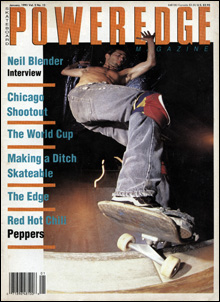
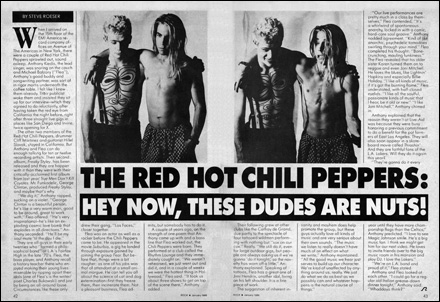
| Goldmine: November 22, 1996 | Poweredge: January 1990 | Rock: January 1986 | ||
|---|---|---|---|---|
  |
LETTER FROM ED ASNERIn the early '80s I was working at a weekly newspaper in Hackensack, NJ, near where I had grown up. I wrote a story about a young New Jersey guy, a freelance writer, who had traveled to El Salvador to research a story, and never came back. I sent a copy of my story to activist and actor Ed Asner (TV's "Lou Grant" at the time), and was extremely pleased when Mr. Asner wrote back to me. <-CLICK TO ENLARGE LETTER |
Steve Roeser tracks down legendary percussionist Remi Kabaka and discusses the Stones, Steve Winwood, Ginger Baker et al with him. Read the complete interview at ROCK'S BACK PAGES.
As of this writing, just past Memorial Day Weekend 2015, many of the originals (or actual founding fathers) of Rock 'n' Roll are still with us. Chuck Berry, Little Richard, Fats Domino, Jerry Lee Lewis, Wanda Jackson and Lloyd Price are all alive.
But longtime fans of classic rock from the 1960s and '70s received a series of jolts over the rough Winter of 2014/15 with news of the deaths (over a 3-month period) of a handful of familiar participants in a ton of great music: Kim Fowley, Jimmy Greenspoon, Bobby Keys and Dallas Taylor. Not household names, you say? Maybe not, but neither is mine. Most likely, not yours either. Nonetheless, these people were a part of our lives, for decades. I will leave Fowley for last, in these brief comments about each man, as he is the only one of the four I ever met, and was somewhat personally acquainted with. (He can be seen at the end of my YouTube video entitled #9: Songs of John Lennon). The others I knew primarily from the many great records they played on. Records that I love, that I bought (in some cases, multiple times), and that I continue to listen to, more than 40 years after I first heard them.
Records that, perhaps, I will listen to until the day I die. Hopefully, I will make it into Heaven (when "that time" comes) and maybe some of those great records can be heard there as well. And just maybe, a few of those records are SO good, that all four of these mortal souls have already achieved "Rock 'n' Roll Heaven" solely on the basis of their important contributions to them.
Even people with only a passing interest in Rock 'n' Roll know many of the records I am referring to, from having heard them repeatedly over the airwaves. Even if you aren't a fan, it is likely that you unwittingly derived pleasure and appreciation from the talents of these men, none of whom was ever really regarded as a "star."
But, for those deep into the music, they WERE rock stars, in the true sense. They took things further than human beings are supposed to, and lived longer than they probably should have, under the circumstances. But the music they made is far more than memorable, way beyond mere "entertainment," and it will live on, and on.
The excesses of the musical era in which they lived are a prime reason why they are now gone, while Chuck, Fats and Richard are still around. Greenspoon and Taylor had enormous problems with drug addiction (and both published books detailing what they went through to survive beyond the 1970s), while Greenspoon and Keys took alcohol abuse far past the point where most people's bodies would have been able to take it anymore.
Jimmy Greenspoon was the keyboards player in Three Dog Night, a band that has yet to be inducted into the Rock And Roll Hall Of Fame, but is more than deserving of the honor. The "knock" against the band was/is that, in spite of all the hit records they had (they were a "singles group" and ruled the Top 40 from the late '60s into the mid-'70s), they didn't write their own material.
That "argument" simply doesn't hold water, especially now that Linda Ronstadt (who became a rock star in the same era, but ultimately preferred recording albums of pop standards and other non-rock 'n' roll music), who did not write any of HER material, has already been inducted. This is not a put-down of Ronstadt, whose records were often excellent. But they were no more excellent than the recordings of Three Dog Night.
Three Dog Night only had seven members, and three of them were the singers, who did not play instruments. So Greenspoon was absolutely essential to the sound of the band, as well as being their musical director, and helped produce (usually uncredited) many of their albums and hits. Listen to the piano, electric piano, organ or other non-guitar parts on any familiar record by the band and it's easy to recognize how much Jimmy G created and contributed.
These include such indisputable classics as "One" (written by Harry Nilsson), "Eli's Comin'" (by Laura Nyro), "Never Been To Spain" (Hoyt Axton), "Old Fashioned Love Song" (Paul Williams) and "Mama Told Me Not To Come" (Randy Newman). In many cases, Three Dog Night came up with the definitive version of songs such as these, as well as a major hit record. Greenspoon's work can also be heard to great effect on recordings that include "Joy To The World," "Easy To Be Hard," "Celebrate," "Try A Little Tenderness" and many others. One of my personal favorites is his playing on "Out In The Country," one of the most beautiful records Three Dog Night ever made.
Although the hits stopped in the '70s, Jimmy Greenspoon continued to tour as a member of Three Dog Night until health issues forced him to quit in 2014. He was 67 at the time of his death. His excellent autobiography is entitled One Is The Loneliest Number.
Bobby Keys played his trademark tenor saxophone on recordings by a truckload of famous musicians over the decades (just check out his credits), but to many he was identified with only one band: The Rolling Stones. Keys had been involved with the Stones (albeit on and off) longer than anyone besides Mick, Keith and Charlie. Long before Ronnie Wood joined the band, Keys was there, as far back as the late Sixties (that's him on the track "Live With Me" on the Let It Bleed album).
The Texas-born musician first met the Stones when they came to America in 1964 and played at a fairgrounds in his part of the Lone Star State. The connection was made there and then, reinforced by the fact that Keys and Keith were born on the exact same day (December 18, 1943). Keys died in December, a couple of weeks before Keith turned 71. The Stones mourned his loss, and in 2015 hit the road without him for the first time in many years. It could be truly stated that Bobby was to the Stones what Clarence was to the E Street Band.
As with Jimmy Greenspoon, you know the man's sound, even if you never knew who he was. That's Keys on the sax solo in the middle of "Brown Sugar," the track that really established his role within the Stones. Also on that album (Sticky Fingers), Bobby weighs in on "Can't You Hear Me Knocking" and he's also featured on a bunch of tracks on Exile On Main Street.
After that classic period, Keys (whose surname sometimes appeared in print as "Keyes"--although the single-"e" spelling seems to be the correct one) was in and out of the band until he returned for good in the 1990s. Another track we know him from is "Emotional Rescue," in which he creatively plays off of Mick's vocal.
Keys, legend has it, even played with Buddy Holly. If the story is true, he would have had to be 14 or 15 years old at the time (but he was definitely playing at that young age). The year he met the Stones they recorded the Holly song "Not Fade Away," a tune the band has continued to play ever since.
Keys also recorded with Eric Clapton (EC's self-titled solo debut), John Lennon (on the former Beatle's only #1 solo record, "Whatever Gets You Through The Night") and with Joe Cocker and Leon Russell on the Mad Dogs and Englishmen tour. His autobiography is called Every Night's A Saturday Night.
If Dallas Taylor had never met and become friendly with John Sebastian, very few people might ever have heard of him. But because Sebastian (recruiting Taylor to play with him upon the breakup of the Lovin' Spoonful) introduced the 20-year-old Texas native to Stephen Stills, Taylor became very famous within a couple of years as the drummer for Crosby, Stills & Nash.
That circumstance proved to be, in the long run, as much a curse as it was a blessing, because 10 years later Taylor (who had played in an obscure band called Clear Light prior to CSN) no longer had any music career at all. His career and his life were derailed by a drug habit that obliterated every cent he ever made as a musician. And because of the success of CSN (and then CSNY), Taylor had made a whole lot of money. All gone.
Taylor (like Keys, Texas-born and bred), got married as a teenager but headed out to California to pursue the dream of big-time music stardom. He found it at a young age by becoming CSN's drummer, playing on the trio's legendary debut album in 1969, and then appearing with them at Woodstock. When Neil Young officially joined the group, Taylor also played on CSNY's Deja Vu album the next year. But, in many ways, that's as good as it ever got for Dallas Taylor.
He detailed all the many ups and downs in his very worthwhile and impressive (though, in parts, hard-to-take) autobiography, Prisoner Of Woodstock. His book may very well be his finest accomplishment, even considering all the great recordings he played on, because Prisoner Of Woodstock is all Dallas Taylor. He wrote the entire book himself, and it's pretty darn well-written. And Taylor knew that he had a story that was worth telling, that could benefit others.
If not for Stills, Taylor may not have made it very far in the national music scene, but sometimes even Stills (whom Taylor regarded as a brother) couldn't help him. Stills included him in the CSN project over the objections of David Geffen, who helped get the group signed to Atlantic Records. (Stills had already recorded for the company, on the ATCO label, as a member of Buffalo Springfield.) Geffen didn't want Taylor to be a part of it, telling Stills that he and Crosby and Nash could do just as well using all studio musicians to help record the album.
But Taylor thought there was another reason why Geffen didn't like him, which was that Taylor had been Laura Nyro's boyfriend for a period of time (probably around 1967-68), a relationship that ended rather badly. Geffen was Nyro's mentor and manager. Taylor even thought that the young Geffen (who published Nyro's many classic pop songs, which included "Wedding Bell Blues," "And When I Die" and "Stoned Soul Picnic") might have been in love with Nyro himself, and was simply jealous of Taylor's relationship with her.
Nyro had apparently been very taken with Taylor, and had even written a song about him, which Taylor mentions in the book as something he thought of as "kind of an honor." (The song, which Taylor does not name, might have been "Timer," which she recorded early in '68.) But it was Nyro who abruptly broke things off with Taylor, after he casually admitted to her his enthusiastic use of cocaine.
Taylor was allowed to stay with the group anyway, but only long enough for Young to make his life difficult a little ways down the road. In a dispute with Stills that sparked after the Deja Vu album was released, Young insisted (the way Taylor tells it) that the only way to settle matters was to fire Taylor from the band. Taylor may have possibly left something out in the telling, but it seemed like a pretty nasty solution to Young's problem, because: a) Taylor was in the band first, b) Young had had nothing to do with getting him the job, and c) Taylor doesn't bring up anything negative that had gone on between him and Young. He was scapegoated, from the looks of it.
This episode perfectly illustrates the shallow, phony, hypocritical, star-tripping side of the music we loved so much: namely, that there was seldom (if ever) any exemption allowed from music industry politics when it came to "carrying on" business as usual. Back then (and quite possibly nothing much has changed up to the present day), L.A. entertainment industry backstabbing seems nearly identical to Washington D.C. power brokering backstabbing. If someone was needed to walk the plank to save someone else's job or career, a convenient victim could always be found. Peace and love? Hey, gimme a break!
The same unpredictability that, in a short time, made Dallas Taylor a rich and famous rock musician also (and just as quickly) turned him into a permanent ex-member of one of the world's biggest bands. And in his book, Taylor ruminates on why the group wasn't called Crosby, Stills, Nash, Young & Taylor.
[Aside: The callous treatment of the young Dallas Taylor reminds me of several conversations I had years ago with another fine drummer, the late Bruce Gary. Bruce is best-known as a member of The Knack, but he never wanted to be remembered for his role in that band.
He was much prouder of his involvement with blues artists like Albert Collins, and other people like Robbie Krieger and Jack Bruce. He was also pretty much of an expert on the recordings of Jimi Hendrix. (In Taylor's book, incidentally, there is included a rather interesting Hendrix story.)
I met Bruce Gary, talked with him, and also interviewed him. He was a talented musician, a funny guy, and seemed like a pretty nice person. Like some other drummers I have met, he made the observation about how little respect the drummer always seems to get in the whole rock 'n' roll scheme of things.
When I met Ginger Baker, he said basically the same thing. "You notice," Ginger indignantly remarked, "that Ringo is the one who got the least out of [being in] The Beatles. The drummer gets the bum deal, and he shouldn't, because the drummer is THE most important thing in any band--ANY band!"
I also knew the late Joey Covington, another very talented drummer (and songwriter), and a good guy. As one of the later members of the Jefferson Airplane, he never received the proper treatment that he felt he was due. He was an original member of Hot Tuna, but somehow got eased out of that situation, despite the fact that it was he who introduced Papa John Creach to everyone.
But I was talking about Bruce Gary, and how his comments related to Dallas Taylor, so I will wrap up with one of Bruce's self-deprecating jokes. He told me several, and I believe he had many more, but this was perhaps the most pertinent one:
Q: "What do you call a guy who hangs around with musicians?"
A: "A drummer."
And there you have it.]
Fortunately for Taylor, Stills was someone with enough of a conscience to make it up to him. He used Taylor on some of the tracks for his self-titled solo album, and then started Manassas with Taylor and Chris Hillman, and promoted Dallas to co-producer on the album. Later, in the throes of his addiction, Taylor signed away all his future rights to the Manassas album to Stills for ten thousand dollars--money that also disappeared in no time flat.
By the time Taylor was in his early forties, he needed a liver transplant in order to continue living. This was not about having a music career anymore, because that was long (time) gone. This was just so that he could live to see age 45. Miracle of miracles (and this is a lot of what Taylor's book is about), a donor was found, the transplant was successful, and he wound up living 20 years longer than the doctors had thought remotely possible at the time.
Required listening for appreciating Dallas Taylor as a musician would be these: the album John B. Sebastian, the first CSN album, Deja Vu by CSNY (&T), the first Manassas (double) album, and Stephen Stills' self-titled debut album. Required reading for appreciating Dallas Taylor as a human being: Prisoner Of Woodstock.
Kim Fowley, who came up on the L.A. music scene around the same time as fellow Los Angeles native Jimmy Greenspoon, was not as well-known as many of the musicians he worked with, and he himself was not really a musician. But he had a brilliant mind and sharp musical instincts, which served him well as a record producer, in a career that began in the late 1950s and went right up to the time of his death, at age 75, in early 2015. Fowley was always working on something, and he just never quit. He couldn't stop, and he couldn't be stopped. Except, finally, by the cancer that did him in.
I had read and heard many things about Kim Fowley before I finally met him in 1993, and told him I wanted to write an extensive feature article on him and his career in the record business--and that I had been given the go-ahead to do so. If I had not been living in Los Angeles myself by then, the story never would have happened. But I lived only a few miles away from Fowley (who at the time was living alone, as was his habit, in a small apartment on Hollywood Boulevard), and he invited me over to tape-record the interview in person.
Well, it wasn't just one interview. It turned into a series of interviews, with a number of return visits, to cover all the decades, and all the details. But the story got done, it ran in Goldmine magazine near the end of that year, and anyone who's interested can still find the story (which Fowley quite liked) on the site www.rocksbackpages.com.
Over the years, I would have sporadic contact with Fowley, who could be very abrasive or very pleasant, depending on what kind of mood he was in, and depending on whether or not he thought you might be using him, or wasting his time. I found him always interesting, a little disturbing, but never dull. He was extremely witty and insightful, and often made me laugh. Fowley loved having an audience, and was never at a loss for words, which is what made him so good as a "radio actor" (as he called himself) on Little Steven's Underground Garage. That, and the fact that he had impeccable taste in records, made his one of the very best music programs on radio.
Yes, he discovered, managed and produced The Runaways. That's one of his "big" credits, that is always mentioned. (He was also portrayed in the Runaways movie.) He deserves much credit for Joan Jett having made it into the Hall Of Fame, and maybe he even deserves to be there, too. I never cared that much about his involvement with The Runaways, though, just like Bruce Gary preferred not to play up his own involvement with The Knack.
In fact, Kim Fowley and Bruce Gary were similar type of guys. They both had that wicked, self-deprecating sense of humor, a touch of ever-present world-weariness, and both knew, without a doubt, what was good (and what was crap) when it came to music.
For as much as he loved and identified with his home town of Los Angeles, Fowley tried to leave it many times, but always returned. When he would move to some distant city, or foreign country, attempting to start a new phase in his musical adventures, he sometimes found that he was not welcome. I remember once in the mid-'90s, Nik Venet (a fellow record producer Fowley admired) telling me that Kim had been booted out of Ireland.
Who knows what Fowley had done (maybe he covers it somewhere in his memoirs), but he just wasn't wanted there. Fowley had a tendency, I noticed, to put HIMSELF down a little too much. He exuded an air of confidence, but I could tell that he knew certain people just didn't take him seriously, and never would. On his weekend radio show on Sirius/XM, he would sometimes sign off as "the King of Slime." I thought that was a terrible way for someone of Fowley's intellect and abilities to refer to himself. I respected him, even if he often seemed not to respect himself.
But Fowley was reasonably health-conscious, never delving that deeply into drugs or alcohol, that I ever heard of. One of his issues seemed to be that he was insecure, a condition caused by the breakup of his parents when he was a kid, and the fact that he'd been placed in a foster home for a period of time. As an adult he did not maintain good relationships with either of his parents. Instead, he dove deeply into the roiling waters of rock 'n' roll, and made it his life.
For the uninitiated, it's tough to decide which Fowley recordings to recommend. Early in his career (circa 1960), he was involved with co-producing "Alley-Oop" by a thrown-together group with a made-up name, the Hollywood Argyles. When I first met him, for the magazine story interviews, he referred to himself as a "one-hit wonder," on the basis of this record. But Fowley actually went on to do much more. There are a number of compilations of his work available but, as with Dallas Taylor, one might be best-served by reading Fowley's book.
Kim Vincent Fowley's own story, first published in 2012, is called Lord Of Garbage. Again, I don't know why he characterized himself in this way, except to say that he probably couldn't help it. Fowley was an honest person, which was perhaps one of the best things there was about him. So, no one would ever expect him to put out an autobiography that wasn't honest. In the front of the book (which purports to be the first part of a trilogy, since it ends in 1969, when Fowley was 30), he describes his childhood as "Dickensian."
Even though I haven't yet read it (as of this writing), I will. The reviews on it are good. In fact, all four of the books these guys published about their lives and careers have been very well-reviewed. I have read Greenspoon's book, and Taylor's, and I can attest to how good those two are. As time allows, I will read Bobby's book, and Kim's.
Leon Russell once praised Fowley as an excellent producer, having worked with him on an album. Fowley wrote lyrics for songs that were recorded by The Byrds on their later albums. He wore many hats in the music industry, and was perhaps the ultimate jack-of-all-trades. He was also a non-stop self-promoter. He pointed out that he had a record label called Maverick long before Madonna did.
Back in the Fall of '93, as our magazine story was about to go to press, I heard through the grapevine that Frank Zappa had not long to live. Fowley had made some remarks about Zappa (having sung on a Mothers of Invention record in the 1960s, and crossed paths with Zappa many times) during the interviews that I thought were perhaps a bit harsh, but I had included them in the story. I called Fowley to ask him if he wanted to revise his comments, or restate them, in light of Frank's short time remaining. (Zappa passed away shortly after the article came out.)
Fowley declined. He said he had told the truth about Zappa, and that was the way it was. Fowley had also once had a falling-out with Warren Zevon (after Zevon had helped Fowley record an album, when Zevon was starting out), and he didn't apologize for that, either. Fowley wasn't someone who was prone to offering apologies, even though he probably ought to have offered up at least a few here and there. That just wasn't him.
I will say this in closing about Kim Fowley. He was a unique character, and I miss listening to his radio show, which I actually loved hearing every week. I'm sorry, too, that I will have no more opportunities to speak with him, as I also enjoyed those occasions. Little Steven delivered an on-air spoken tribute to Fowley that was heart-felt and powerful. I agreed with every word of it.
I urge the reader to learn what you can about Fowley, and from that, decide for yourself what music of his to seek out. His output was so varied, that most people can't relate to the scope of it. All I can say is, I believe that rock 'n' roll would have been less without him, and a lot less of a good time.
--Steve Roeser
Coda:
A few days after I had finally concluded what I wanted to write about these four men, whose musical accomplishments I felt were worth talking about, with Kim Fowley being the very last part of the piece, a story circulated on the Internet alleging that Fowley had, back in the 1970s, raped one of the members of the girl group The Runaways.
I did not read the entire story that the report was based on, but the key points highlighted in the article were pretty horrible to think about. It's hard to imagine that Fowley would have actually done something like this, especially to a girl who was then 16 years old, and someone he was responsible for.
The person who made the allegations against Fowley was Jackie Fuchs, now age 55, and a lawyer herself. Her music career did not go beyond her time in that group, apparently, but she did go on to get a great education, receiving her law degree at Harvard. As the bass player in The Runaways she was known as Jackie Fox.
I want to make several points, the first of which is, that the preceding story was just as much about Greenspoon, Keys and Taylor, as it was about Fowley. It just so happens that Fowley is the only one of these men who I met in person. I became somewhat acquainted with him during the last third of his life, but it would be untrue for me to claim that I ever got to know him really well on a personal level. I simply found more to say about him because of the conversations we had. Fowley and I were never friends.
When the story hit about Fuchs and her claims against Fowley, I initially thought of revising what I wrote about him, to change certain comments I made, or take things out. Then I decided not to do that, but to add this postscript instead. I admit that I liked Fowley, and a story like this is upsetting to hear and to process. I had said that Fowley (in my view) was "an honest person." But it could be that he was only honest about the things he chose to speak about.
The incident in question, which allegedly took place on New Year's Eve 1975, after a Runaways concert in Orange County, California, was many years prior to my having had any contact with Fowley. When I was contemplating writing a story about Fowley's career, and speaking with people about him, nobody suggested to me at any time that there were "rumours," or anything of the sort, that Fowley had ever physically abused members of The Runaways, or any other females he had worked with. If such talk had filtered down to me, I quite likely would have concluded that I didn't really want to talk to Fowley after all, and I just would've turned my attention to something else.
As I said above, I never cared that much about The Runaways, so I actually know very little about the group, its history, or what went on around it. At the time the group was functioning in Hollywood, I wasn't living in California, and at that point did not even know who Kim Fowley was. I am also not here to either, A) cast doubt on what Jackie Fuchs is saying happened back then (with others witnessing it, including more than one of her bandmates, she states), or B) to be an apologist for the late Kim Fowley.
I was never an apologist for Fowley while he was alive, and I won't be now that he's gone. Certainly I was aware, as were many others, that Fowley had a reputation for being "controversial," "notorious" (these were adjectives he propagated about himself), and behaving like a wild man, especially when he was younger. But this is another level altogether of out-of-bounds behavior. Was Fowley really this out of control back then? If so, how could he be so reckless, so heinous, so totally irresponsible, so cruel, so criminal? How could he be so evil?
I repeat, I'm not saying I believe that Fuchs is wrong, or that she is concocting a story. All I'm saying is, Fowley is survived by friends and family members who cared about him, and it is now left to them to defend his name, since he is no longer around to defend himself. Going forward, I have no idea how that will play out. Fuchs said that part of her motivation for speaking out now has to do with all the women who are claiming that they were drugged and raped by Bill Cosby. (Fuchs also says she was drugged that night.)
For a moment, let me compare this alleged incident to the situation that sent Phil Spector to prison, quite possibly for the rest of his life. Obviously, the Spector case is worse. But, what if Fuchs, or one of the others there on the night in question, had called police and Fowley had been arrested? What if a rape case had actually been pursued against him, and he'd been found guilty?
Well, then it's almost certain Fowley would have gone to state prison, right where Spector still is now. But the fact is, no charges were ever brought. If Fowley had been tried for this alleged crime (and we're obviously talking about a serious crime here, not just a case of seriously poor judgement on the part of a man who was supposed to be looking out for the welfare of teenagers), and found guilty, then the story of his career in music would've been entirely different.
So, when I said in my story that I "respected" Fowley, I was saying that based on the person I got to know through my own time spent talking with him. Could Fowley have been a "changed" or "reformed" person by the 1990s, when I finally met him? I don't know the answer to that. Since I never knew him when he was young, I can't know how much he might have changed, or improved himself, over the years. But I do know that some people, whether they are ever charged with a crime or not, do want to become better human beings later in life. Some of them work hard at accomplishing that, and some of them succeed. Again, I don't know if Fowley was one of those people.
I also said in my story that I found Fowley "disturbing" at times. I said that because I think there was something "damaged" about Kim Fowley, which even he would admit to. He saw himself, I believe, as a social misfit, and he actually was. He attributed that to his unhappy childhood. I believe that Fowley projected something about himself that was disturbing, because he was deeply emotionally disturbed by the events of his own childhood, which he revealed to me in the interviews I did with him. Nevertheless, that didn't give him the right to take it out on anyone else, of course. And I'm not saying that he did.
I also said that Fowley probably should have offered up some apologies to certain people later in his life. Did he ever try, in any way, to contact Jackie Fuchs, and attempt to make amends in any way? Is it even possible, for someone to make amends to a victim in an instance like that? Again, I don't know, and I also don't know what Kim Fowley did or didn't do.
I feel sad in the wake of the allegations by Jackie Fuchs. A lot of us don't want to think of Fowley that way. But, of course, there are a lot of Bill Cosby fans (or former fans) who never wanted to think of him that way, either.
If anything good can ever come of this, hopefully it will be that parents keep a close watch on their children, at least until they turn age 18. If you, as a parent, are going to allow your son or daughter to participate in something like being in a band, or being on a sports team that travels long distances, or anything of that sort, then you had better be very careful about whom you are entrusting your teenager to. Maybe the families of the girls in The Runaways trusted Fowley when they shouldn't have. Each girl should have had a family member present, whether the band member wanted it or not. Just to be safe. Those girls were probably in more danger than their families, or they themselves, ever knew.
For now, Fowley's reputation is definitely badly damaged. That's pretty undeniable. He continues to be controversial, to his grave. I wish we lived in a better world, where people acted with kindness and consideration, and never did terrible things. But it seems that part of what Fuchs is saying is that, at the time, Fowley had the power to do something like that, and get away with it. That is an awful abuse of power, if it's true. And again, I'm not casting doubt on what she is saying. It's not for somebody like me to do that.
So, as much as I'd like to think that Kim Fowley might have achieved "Rock 'n' Roll Heaven," I could be wrong about that. God help us all.
S.R.
SUBJECT LENGTH FORMAT ARIF MARDIN [1932-2006] (3/31/1999)
If one were to try and compile a list of the greatest record producers of all-time, surely Arif Mardin would rank near the top of that list. He worked with many great artists during his long career, and made many artists greater by virtue of having him as their producer. When this 1999 interview took place, he was still working for Atlantic Records (where he was employed for much of his time in the record business), and he discusses his association with numerous Atlantic acts. Those included John Prine, Roberta Flack, The Rascals and Average White Band. But at the time of this discussion he was also still several years off from producing one of the most memorable albums of all, Come Away With Me, for Norah Jones.
39:58
MP3
Windows Media
RealAudioADOLFO "FITO" DE LA PARRA OF CANNED HEAT (6/3/1994)
Fito was not the original drummer in the legendary American blues/boogie band Canned Heat but he is, by far, the longest-serving member, and the band's leader since the 1980s. Here he discusses the late Sixties era, and the album they made with blues great John Lee Hooker in 1970.
30:59
MP3
Windows Media
RealAudioWARREN ZEVON (6/29/1995)
Warren Zevon (1947 - 2003) was an outstanding songwriter, musician, singer, performer and recording artist. As I found out, when I had my one and only opportunity to speak with him in June of 1995, he was also a gentleman, and a person filled with insights into all kinds of things in life. Some people thought of him as a humorist. He never denied being an entertainer. He knew perfectly well that was one of the things that enabled him to have a career. To me, he was just an immensely talented artist, and a brilliant guy. Listen now:
PART 1 (44:54)
PART 2 (42:25)
PART 3 (15:03)
MP3
MP3
MP3Windows Media
Windows Media
Windows MediaRealAudio
RealAudio
RealAudioTAYLOR HACKFORD (6/22/1990)
Taylor Hackford is a movie producer and director who was literally "raised on rock 'n' roll," and it shows in his films. He began his career with The Idolmaker, a fictionalized yet very realistic (and excellent) film about the late '50s/early '60s period in American Pop Music. A few years later, Hackford made a very engaging documentary on Chuck Berry, in which Keith Richards and other top talents were deeply involved. He also produced the movie La Bamba, the story of Ritchie Valens. Hackford has also been very successful in making films in other genres, such as the acclaimed An Officer And A Gentlemen (Richard Gere, Debra Winger, Lou Gossett, Jr.). Committed filmmakers take note: this 1990 interview concludes with a question about Hackford's "Ray Charles movie" (at one point set to be titled Unchain My Heart), which he had already been working on for several years. It took Hackford ANOTHER 14 YEARS to complete Ray and have it finally shown in theatres in the Fall of 2004. Taylor Hackford may yet have another movie up his sleeve about the world of music, before he's done working.
45:34
MP3
Windows Media
RealAudioERIC BURDON (June 1990)
Born in Newcastle, England in 1941, Eric Burdon was lead singer of The Animals, a hard-edged R&B group that appeared on The Ed Sullivan Show in 1964 (six months after The Beatles first did), performing their classic #1 recording of "House Of The Rising Sun." Heavily influenced by American blues and soul singers such as Jimmy Witherspoon, Sam Cooke and John Lee Hooker, Burdon fought hard for the integrity of the music he loved. When the original Animals broke up, he moved to California and continued on with Eric Burdon & The Animals, later becoming lead vocalist with War ("Spill The Wine"). Since the 1970s, Burdon (inducted into the Rock And Roll Hall Of Fame as a member of The Animals) has persevered in music, recording, performing and touring around the world. Listen now:
CLICK THUMBNAIL IMAGE TO SEE FULL-SIZE SCAN
32:20
MP3
Windows Media
RealAudio
Bob Dylan sings "Garden Party" (May 15, 2025)
Barry Goldberg Discusses Mike Bloomfield and the Book Two Jews Blues
"The Weight" performed by The Band at Woodstock (1969)
"The Weight" was recorded by The Band for their debut album, Music From Big Pink, and
appeared on that album upon its 1968 release (the last song on Side 1). The arrangement
of the song is unusual in that Levon Helm sings the first three verses, then Rick Danko
sings the fourth verse, and those two plus Richard Manuel (and perhaps Robbie Robertson
also, who is credited with writing the song) all join in on the final verse. Richard also
provides backing vocals, and the high falsetto part that ends the song.
"The Weight" performed by Bob Dylan and guests in Hoboken, NJ (2013)
Bob Dylan has never recorded his own version of this song, in spite of his close
association with The Band during the Sixties and Seventies. (A Dylan painting was
used as the album cover art for Big Pink, and he also wrote or co-wrote three of
the LP's songs.) Dylan did, however, perform the song during his Summer 2013 tour.
#9: Songs Of John Lennon
The Morrison Hotel
Percy Mayfield - Stranger in My Own Home Town
Sharonmarie Fisher & Petals at Sacred Grounds (San Pedro) - June 28, 1998Featuring Seva Venet, nephew of famed record producer Nik Venet, on lead guitar.Peter Green's Fleetwood Mac - "Oh Well", Live@ Music Mash 1969
Peter Green-era Fleetwood Mac on the BBC's Monster Music Mash in 1969.
Alan Price, original keyboards player in The Animals, introduces the band. Left to right:
Jeremy Spencer (maracas), Danny Kirwan (guitar), Peter Green (guitar & vocals). Barely on camera: John McVie (bass), Mick Fleetwood (drums & congas).
"The Weight" - lyrics - page on Bob Dylan's official site
BobDylan.com - homepage for Bob Dylan's official site
Rock's Back Pages: Steve Roeser's articles and audio interviews
Woodstock, New York, Home Seen on Iconic Bob Dylan Album Cover Lists for $5 Million
CLICK THUMBNAIL IMAGE TO SEE FULL-SIZE SCAN
Please note: in the mid-'90s, I wrote for Discoveries magazine for a few years using the name
"Paul Gabriel." There are some back issues where my byline appeared as such. - SR
All orders shipped from Los Angeles, California.
No international or overseas orders can be processed
at this time - domestic only, within the 50 states and
United States territories. Thank You.
| GOLDMINE | ||||
 |
 |
 |
||
|---|---|---|---|---|
Goldmine issue # 426, November 1996 (182 pages) Steve Roeser feature story on the Chili Peppers (8 pages), plus an interview with Roger McGuinn, and an article on singer Yma Sumac. $13, shipping price included |
Goldmine issue # 479, December 1998 (168 pages) Steve Roeser interview with Grace Slick (9 pages); cover photo by Henry Diltz. Also in this issue: a review of a George Jones concert that took place at the Chicago House of Blues, and a report on the reuniting of the band The Pretty Things. $17, shipping price included |
Goldmine issue # 475 October 1998 (148 pages) Steve Roeser definitive article on the history of Grand Funk Railroad (used as the basis for the Behind The Music documentary on the band), plus an interview with Dave Alvin of the Blasters, and a story on the post-Blackmore history of Deep Purple. $13, shipping price included $13, shipping price included |
||
 |
 |
 |
||
Goldmine issue # 458, February 13, 1998 (176 pages) Steve Roeser interview with the great Link Wray (6 pages), cover story on The Cure by Dave Thompson, plus a big story on Prince and the artists he produced, written by Thomas Kintner. $18, shipping price included |
Goldmine issue # 466, June 5, 1998 (166 pages) Steve Roeser interview with Ozzy Osbourne (8 pages), plus an interview with Slash, an interview with Ronnie James Dio, and a feature article on the metal band Judas Priest. $13, shipping price included |
Goldmine issue # 472, August 28, 1998 (144 pages) Steve Roeser interview with Robbie Robertson (8 pages), plus a story on Nils Lofgren, and a great story on singer Hadda Brooks, written by Mr. Jim Dawson. $18, shipping price included |
||
 |
 |
|||
Goldmine issue # 473, September 1998 (164 pages) Steve Roeser interview with Leon Russell (7 pages). Also in this issue: a Q&A with guitarist/singer George Benson, and one with bluesman Tab Benoit, as well as the featured article on Eric Clapton. $13, shipping price included |
Goldmine issue # 453, December 1997 (232 pages) Steve Roeser story on the life and career of Phil Ochs (10 pgs). Issue also includes a Q&A with Neil Young and one with bluesman Lonnie Brooks. $13, shipping price included |
|||
| DISCOVERIES | ||||
 |
 |
 |
||
Discoveries issue # 96, May 1996 (166 pages) Steve Roeser (as "PG") feature profile of Eddie Money, based on an in-person interview with Eddie in Los Angeles in the mid-1990s. Also in this issue, an in-depth story on country singer Charley Pride, written by Don Charles, and a story by Peter Grendysa on the Mills Brothers. $19, shipping price included |
Discoveries issue # 163 December 2001 (100 pages) Steve Roeser (with Mike Giangreco) interview with singer/songwriter Country Joe McDonald. Also in this issue, an interview with the Reverend Horton Heat, and a story on Leon Russell's post-Shelter record label. $15, shipping price included |
Discoveries issue # 175 December 2002 (80 pages) Steve Roeser article "The Beginnings of British Blues," based on original interviews with musician Dick Heckstall-Smith, and Cream lyricist Pete Brown. Also in this issue, an interview with the late Jack Bruce, and a story on 1950s R&B group the Clefs. $15, shipping price included |
||
 |
 |
 |
||
Discoveries issue # 82, March 1995 (162 pages) Steve Roeser (as "PG") feature on the history of The Knack, based on interviews with the late Doug Fieger (on left in cover photo) and the late Bruce Gary (top center). Also in this issue: A story on Greg Shaw and Bomp! Records, a feature on singer Barbara Lewis, one on The Fleetwoods, and a shorter piece based on a chat with Eric Burdon. $13, shipping price included |
Discoveries issue # 137, October 1999 (152 pages) Steve Roeser story on the history of Savoy Brown (9 pgs), based largely on interviews with Kim Simmonds. This issue also includes a column by Cub Koda, and an article about the British band Jigsaw. $13, shipping price included |
Discoveries issue # 152, January 2001 (114 pages) Steve Roeser story about the ill-fated Moby Grape (7 pgs), based on interviews with all band members except Skip Spence. Issue also includes an article about books pertaining to The Beatles. $13, shipping price included |
||
 |
 |
|||
Discoveries issue # 75, August 1994, Woodstock 25th Anniversary issue (134 pages) Steve Roeser (credited as Paul Gabriel) features on the history of Canned Heat, and on the late Richie Havens, based on several author interviews with Richie in the '80s and '90s. Also in this issue: a Q&A with Gordon Stoker of The Jordanaires, and a Q&A with the late Alvin Lee of Ten Years After. $13, shipping price included |
Discoveries issue # 117, February 1998 (142 pages) Steve Roeser Q&A with Sixties songwriting legend P.F. Sloan. Also in this issue: Zappa, Charles Mingus, and "The Dead." Plus a Cub Koda column. $13, shipping price included |
|||
All back issues are in Very Good (VG+) or Like New condition.
ORDER DIRECTLY FROM STEVE ROESER
PayPal to: steveroeser33andathird@gmail.com
Please provide complete name
and current/updated address
information when ordering.
CLICK THUMBNAIL IMAGE TO SEE FULL-SIZE SCAN
 |
Leonard Feather (1914-1994)
What Roger Ebert was to film criticism, Leonard Feather was to jazz criticism. He may well have been the greatest jazz critic/writer of them all. But beyond that, Leonard Feather (born in England, but having lived for many years in the U.S.) was a great proponent and ambassador of jazz music, as well as a successful songwriter. One of his well-known compositions, "How Blue Can You Get?" (written with his wife, Jane Feather), was recorded by B.B. King, Louis Jordan and Duane Allman, among others, and was performed live by The Rolling Stones. His daughter, Lorraine Feather, is a noted lyricist and jazz singer who has recorded under her own name, and also as a member of the vocal group Full Swing. Mr. Feather very graciously wrote me this letter in response to my request to interview him. I had admired his work for many years, and was looking forward to the chance to meet him. But exactly one month later, a devastating earthquake struck Los Angeles (where we both were living), demolishing his home. Unfortunately, our planned interview was never to take place. But Leonard Feather's excellent writing lives on in his memory, and in memory of the many giants of the jazz world who were his contemporaries. |
|
 |
||
|---|---|---|

Paul Williams, the writer (1948-2013), was a remarkable guy. He founded Crawdaddy! magazine in 1966 (before Jann Wenner started Rolling Stone magazine) and was Crawdaddy!'s original editor and main writer/reviewer. He revived the publication in the 1990s, because he loved music. One of the best pieces of mail I ever received was this postcard from him. Please visit www.paulwilliams.com and also seek out Paul's excellent writing. --S.R. |
 |
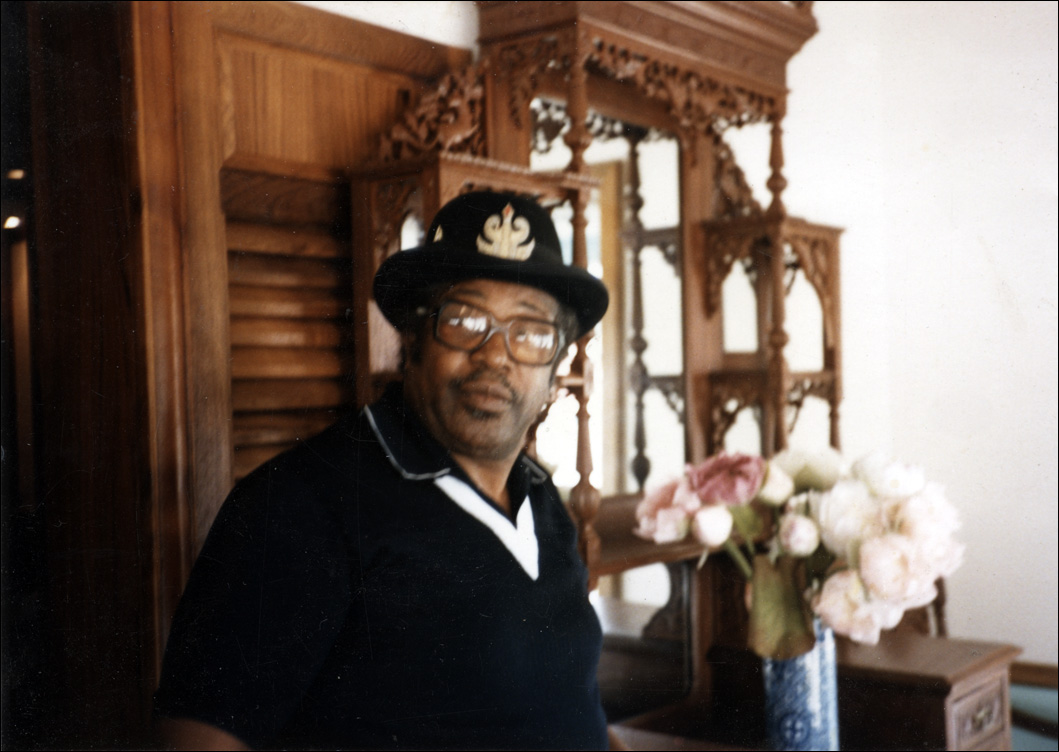
Bo Diddley Hollywood, California 1988 (Photo by Steve Roeser) |
 |
A couple of years after the catastrophes, chaos and confusion brought on by the events of 9/11, I began visiting friends of mine living in Plainfield, Illinois, which is about 60 miles south of Chicago. While driving around that area, I noticed this signpost on the side of a county road, stopped and took a picture of it. The next time I visited my friends in Plainfield, about a year later, I drove down the same road only to discover that the sign (along with its wooden post) had vanished, with nary a trace that it had ever been there. How fleeting the fame of an American politician. --S.R. |
CLICK THUMBNAIL IMAGE TO SEE FULL-SIZE SCAN
| Dylan album cover, circa 1965 | Roeser digital resume cover, circa 2005 |
|---|---|
 |
 |
 |
 |
 |
 |
 |
 |
 |
 |
Most of us have noticed at some point in our lives that we share a birthday with some public figure whose work or talent we admire. In the world of music, I have two such people: one older than me, and one much younger.
And both are fans of The Band. So, that's something else I have in common with them.
One is Eric Clapton, who of course appeared at The Band's Last Waltz concert in San Francisco in 1976, and can be seen in the Martin Scorsese documentary film, performing "Further On Up The Road" with them. Clapton has also recorded in the studio with members of The Band.
The other is Norah Jones. In 2004, not long after she had become a huge star on the basis of her debut album, she was asked to "curate" one of those "artist's choice" CD collections ("music that matters to her") that you'd see on the counter at Starbucks. Among her 14 selections were great tracks by Nina Simone, Donny Hathaway, Willie Nelson and Ray Charles. And track #4 was "The Night They Drove Old Dixie Down" by The Band.
There is a radio station in Southern California (100.3 FM, "The Sound") that features a one-hour program every Sunday evening called "My Turn." Sometimes the guest DJ is somebody who is known from the music business (The Cars guitarist Elliot Easton has been on). But sometimes it might be an actor or actress.
On October 20, 2013 the guest DJ was Eddie Money, and one of Eddie's picks was "The Night They Drove Old Dixie Down" by The Band (from their classic second album, 1969).
One week earlier (10/13/13), 83-year-old actor Ed Asner took HIS turn behind the mike from 6 to 7 pm, and included as one of his selections "The Night They Drove Old Dixie Down." Ed also made a few comments about how much he loved The Band (after all, he was only 40 when the album came out) and said that the group's music has meant a lot to him over the years.
But wait a MINUTE, Chester -- Ed's OTHER picks included "Layla," "House of the Rising Sun," "Oye Como Va," "Smoke On the Water"[!] and the Creedence version of "I Heard It Through the Grapevine." (Ed celebrated his 84th birthday a month later.) Does this sound like the typical playlist of a modern-day Grandpa?
Ed Asner rocks!
|
|
© Copyright 2015-2026 Stephen Roeser. All Rights Reserved.
Site design © Copyright 2015-2026 Earl P. Reinhalter. All Rights Reserved.
Webmaster's site: ElectricEarl.com

